Search This Blog

Showing posts with label Horror. Show all posts

Wednesday, January 23, 2013

Is this a game?


eXistenZ is an odd movie. First of all look at the name. Take it all in, and be reminded that all the capitalization in the name is correct. Just looking at the name you expect something that is fucking weird, and it delivers, it delivers in spades. Remember Inception? Well it's kind of like that for games and not a bad movie. There are less pointless action sequences and it all makes some sense within the world that is clearly not our own. Also unlike most game movies that kind of ignore or most of the time insult their audience eXistenZ doesn't do any of those things because it presents a very different gaming experience, one that doesn't exist but is possible in the foreseeable future.

The main device of the film, that of a game that puts you in a complete alternate reality is not unknown. Ignoring the videogame portion of it the concept of an alternate reality is fairly common in science fiction, though less common in Canadian horrorish films. The film is not a horror in that there is no real villain and there is a decent amount of comedy but a lot of the imagery associated with the film is relatively horrific, including the game controller itself. The controller is effectively a blob of flesh with a few fleshy bulges on it that functions as buttons. They also all come with umbilical cords that plug directly into people's backs in a strangely sexual way, ie penetration and lube are both mentioned and shown.

Back vaginas is what I'm trying to say. But back to the actual controller ports and not the weird ports on humans the things are a hell of a lot more biological than it appears at first glance, actually having organs and bleeding when one is dissected later in the film. Essentially they are more living than most of the insects that buzz around, and the way the main character treats it the controller is more similar to a pet like a cat or dog than anything else. This weird relationship is further heightened by the way people talk about the game, as if it is a need more than a want. Effectively the game that has been created is a drug and the female protagonist is the cook.

There is something about her eyes that just betray the pangs of addiction as she pleads to be let back in to the fantasy world that she has spent five years working on, and just needs the chance to play. That need is what indicates that it is something more than just a game, and even more than something like World of Warcraft is nowadays with people literally dying playing. If something like this was created in modern day there would be a huge number of deaths as people ignored all their needs to play the game. A time distillation effect is mentioned but considering how dedicated some Otaku are it seems likely they would still manage to starve or die of thirst before returning to the real world which seems 'less real' than the game after playing it for only a few hours.

eXistenZ shows what happens when something like this is created, a game which can replace reality. Sure there are games like the Sims and Second Life but an AR game like the eponymous one is so clearly different for one crucial reason. There is no user interface, or controller, or anything to distract the player from the game. Even if they feel the hunger pains they will ignore them to explore a magical world with no consequences beyond resetting the game, a world where they can do anything. It might cut down on crime even because a player could murder and steal and do everything they wanted and have it feel real, but it wouldn't hurt anyone in 'real' life.

Of course if a technology as advanced as this was created the question of what is reality would be brought up frequently, and debates would rage over whether is was suitable to use with children and whether it was harming the populace who used it. There are always debates, but as shown in the movie this kind of technology might cause a further divide. Not only would people get angry about it and make an internet post, but people might actually resort to murder to destroy these kind of things before they became mass produced, before everyone began to descend into their own fantasies about good and bad and everything that is fucked up about the world.

The ending has a sort of Matrixy feel to it as there is the question of whether or not reality is just a game, is it all just layers on layers of falsities and if it is does it matter? The question is not answered and it ends on that note, one of confusion and doubt because honestly there is no proper answer. Sure, I believe that in the film the final scene is in reality, but if one can be created that feels so real than what is the advantage of one over another? That is the debate that would rage and it is certain that some people would descend into these games and never came out, no matter who it hurt including themselves. It could be the best thing in the world to live a virtual world where anything is possible and there are no consequences, ever.

Saturday, January 5, 2013

The Evil Dead

The Evil Dead Franchise is one of few truly good trilogies. There are many good movies with great sequels, but the third installment always seems to be the trickiest, tripping up franchises like the Godfather, or just about any comic book movie that can be named. But the Evil Dead movies are some of the most consistently high quality films out there, only rivaled by something like Toy Story, or debatabley Star Wars or Lord of the Rings, big blockbusters with major studios behind them. The Evil Dead franchise had none of that, just Bruce Campbell and Sam Raimi before either of their names meant anything.

One of the most interesting things about these films is how they shifted over time. They all have some horror elements, featuring blood and gore and terrible monsters, but it shifted away pretty decidedly from straight horror around the second film, and the third, Army of Darkness, drops it completely. The first is a B-horror, but a very good one. Blood spurts and monsters growl and there is a scene with tree rape but overall it is a good horror film with a very solid and atmospheric first fifteen minutes and a sometimes funny but often frightening latter two acts.

Evil Dead II is where the series really shines though, brilliantly combining horror and comedy, often jumping between them very quickly, within seconds of one another. The film also often goes from moments of shouting blood to immense silence, waiting for demons to come through any of the openings into the cabin, as they frequently do. The first was the quintessential cabin horror movie, lovingly mocked by the recent title The Cabin in the Woods. The second takes the concept and throws it on its head long before the meta concept had become so accepted. It shows what was a normal horror movie and laughs at it, literally in the case of one scene were the entire house begins to laugh after enormous geysers of blood had shot out from the wall.

That is the essence of the film, violence at a contrast to utter insanity and slapstick. Several of the actions in the film are taken nearly directly from the Three Stooges, though adding a good dosage of blood. Essentially the film is to normal horror what Shaun of the Dead was to zombie horror. It delights in this, with the main character, Ash, putting on just the right expressions screaming and shouting but looking defiant at precisely the right moments. The film is not a deep examination of why horror movies are popular, nor does it try to look deep into the human condition and explain why we do all that we do. It is simply a great B-Horror-Comedy thing that rides the line and manages to overcome the pitfalls of both genres.

Army of Darkness takes the ridiculous parts from the previous film and multiplies them by ten. Finally having a budget Raimi is able to direct a final fight involving knights and zombies and cars and an infinite ammo shotgun with one liners spouted after every kill. This is what the previous films were leading up to, the patent ridiculous overloading any sense of disbelief the audience had and going straight to awesome. That is the goal of any sort of action comedy, and it does it brilliantly, again highlighting the ridiculous of the concept and embracing it like any good B-movie.

Overall the series shows a sense of progression that is rarely seen in films. It's not a forced change like the sequels to The Land Before Time or the gradual degradation of a villain like the Nightmare on Elm Street movies, it is simply a forward progression based off the conventions of the genre and an attempt to subvert the expectations of the audience. There are few directors who could pull this off, as it requires an understanding of audiences and genres that simply is not had by many directors. Tarantino was able to do it with Kill Bill part 1 and 2, with all the violence in the first and talking int he second but that was a very rare case and only extended to two films, as well as not exactly changing genres, just changing focus.

Of course going from splatter horror to comedy could also be thought of as just changing focus. Most horror can become inadvertent comedy with just a little change, like to the music, or quantity or color of blood. Given how accustomed society has become to violence it only makes sense to combine the two, it is more of a natural extension than anything else, as shown by a recent upward swing in horror comedies. Overall the Evil Dead franchise has stood the test of time and will continue to be a cult movie for decades to come.

Thursday, July 19, 2012

Cleavleand Screamer

Let's look at the Scream series.

Created by the master of horror Wes Craven it restarted a dying genre by doing something unique, which everyone promptly forgot when the dozens of imitators popped up. The original Scream did something that was already tried in the financially failed but critically successful New Nightmare, the final Nightmare on Elm Street movie. It was meta, it referred to genre traditions and stereotypes and played with them while still embracing them. That's what made the first two films great.

They used the humor elements from later Nightmare movies while still keeping the horror because the humor was mostly ironic or in separate scenes from the main villain. It also established Ghostface as a credible threat, a faceless entity who could appear and disappear seemingly at will. It also had a great twist at the end which was not just a jump scare. Because the killer was unknown for so much of the movie it became kind of a murder mystery or who done it which added to the appeal.

The final selling point was casting known and popular actors instead of the no-names traditionally cast. This helped make the film seem current and unlike most attempts by movies to seem hip it actually worked because of director Craven's knowledge of both horror and pop culture. So with all these elements the franchise started off a revival of the classic slasher genre, but what movies did it actually inspire?

The list of good slasher, or hell, horror films from the 2000's is shockingly low, especially if you restrict it to just American made pictures. The late 90's had films like I Know What You Did Last Summer and its sequels which did relatively well at box office but failed to impress critics, and that was one of the better ones. Most of the shitty ripoffs have faded into obscurity, and though it also brought back some classic villains with the likes of H20 and Jason X nothing really very good come out of it.

The problem with many of the slashers was they didn't have an identifiable villain. The reason we remember Halloween was because of Michael Myers, who started off a trend that also brought Jason and Freddy as well as bringing to the forefront older villains like Leatherface and Pinhead. These icons were what defined horror of the late 70's and 80's, and the 90's simply didn't have it. Ghostface was the only memorable face, excluding things like Chucky which were not so much imposing as stupid.

So the Scream series started a so called 'revival' but in the end it floundered again until horror was brought up again with torture porn like the Saw franchise, at least in the States. The first two Scream films showed a ray of hope on what had been a dying genre, but like all villains it kept coming back, even after it should have settled in for a final death. Slasher movies simply can't be made anymore, as the remakes to old franchises show audiences don't appreciate it as much and critics still don't like them. For now I think Slashers should lay dormant, resting on the laurels of the past instead of shitting on them with countless sequels and remakes.

Sunday, May 27, 2012

The Woman in Black


     The woman in black is a fucking bitch. Seriously she just keeps killing kids for almost no reason, and even after her son is brought to rest she doesn't stop, though she does pretend to just to troll everyone. With a soulless villain like that you have the beginnings of a decent film. What makes this a decent film is firstly it wasn't made in the Noughties, which produced very few to non decent horror films, and secondly it tries to evoke a more gothic type of horror, which can be very effective when coupled with a decent director and actors, and besides Daniel Radcliffe they are.

     Now with Harry Potter as the lead actor it is a little bit strange, but it works alright after maybe 10 or 15 minutes, you even sort of forget that Daniel is the lead actor. As a character he is kind of a blank slate, but he does have a driving motivation of his son, so he has like maybe 2-dimensions, which is not bad for a horror protagonist. Our villain is a fairly standard ghost, bringing back other ghosts, though they don't seem to affect anything physically, just mentally scarring the townsfolk. The people themselves are standard cliches, fearful of foreigners and ominous about the location of the film.

     The location of the film is great for a horror film, a mansion in the middle of nowhere, with rolling banks of fog, a path which disappears when it is convenient to the plot, and even a dark forest if you need that. The house itself is a great example of a Victorian haunted mansion, with lots of candles, hallways, staircases, and creepy children's bedrooms. Apparently the toys of the era where absolutely terrifying, with the whole range of creepy, clowns, monkeys, the blank stares of dolls, and good old fashioned self rocking chairs. The whole gamut really.

     The main question of any horror film is of course is it scary, which I can answer with a resounding probably. It's got some good images, a fairly scary lady ghost, and a good amount of creepy children, with a array of different murder methods. There is also a good sense of desolation with Harry being the sole person in the house for much of the film, including just about all of the actual horror stuff. There are a few cheap jump scares, but overall it is mostly atmosphere, and fairly well done at that. Admittadely they could have done more with the environment, and probably should have given its roots, but you take what you can get.

     There are a few things that don't work, such as the downer ending not really making too much sense. They could have had a nice simple ending, ghost defeated and all that, but no it is a horror film so has to have a shocking ending. Also they forget about the dog that was in the house which was kind of weird. They made a point to include it, then just kind of, forgot. Also Harry's acting is a little bit okay, I mean he's never been great, and it's on show here as he has to do a good 80% of the acting. Overall though it's a decent horror, with a few scares, and an actual decent finale, an issue that many horrors have a lot of trouble with.

Wednesday, May 23, 2012

Evangelion 3: The Search For Love


          Despite the fact that she calls him an “arrogant bastard” who expects her to “come when he calls” she still obeys him, though not completely. She slips in a self-destruction program but it is ultimately defeated by her mother’s mistakes, a common theme throughout the series as her mother chooses her lover over her daughter, choosing Gendo over everything else. Despite Ritsuko’s repeated statements that she doesn’t want to be her mother in the end she is led to her downfall by both of their mistakes, and ends up dead for it, just like her mother.

            Misato arrives at the command deck and takes control, very decisive even with everything that has been going on in her personal life she is still cool and collected in a time of high stress. She forgets about everything else when the time comes that she needs to be a leader effectively ignoring everything else, pushing it to the back of her mind and bottling it up until the current conflict is done, resulting in her crashing in her personal life and her relationships destroyed because she doesn’t really understand her emotions outside of combat.

            The sole computer that remains is Casper, the personification of the lover, as opposed by the mother and scientist. The others are also named for one of the three original wisemen, Balthasar and Melchior. The computers stand as the voice of reason more than any human being, and their destruction or take over is treated as one of the worst possible things, worse than losing any single person. For Ritsuko however it is much worse, it is losing the last thing her mother left to her, and in fact essentially losing her mother again, which is why she is so adamant in defending it even though it means working for someone she hates. As she leaves the bowels of the machine she comments how she will see her mother again, knowing her death is soon at hand.


            Soon after there are some beautiful images of the greenery outside of Tokyo, but it is disturbed by armed forces rushing in and destroying near everything, indicating that the end has begun for NERV, and at the hands of humans not the eldritch abominations they were fighting. It is ironic that the last Angel, Kaworu is arguably more human than these military soldiers who are nameless and wear identical uniforms. Kozo comments that their “final enemy is man” as opposed to the spectral incredibly deadly angels, and that is actually who they lose to, fellow humans.

            Makato when confronted by the fact that the human soldiers will soon be assaulting them says he wishes that they would acknowledge that they are all humans, and should not be fighting amongst one another. Despite this he is still willing to fight and kill when it comes down to his life or others. The soldiers are then shown mercilessly slaughtering members of the NERV defense force who are almost unaware of what’s happening, and definitely not prepared for any of this kind of violence. This is shown clearly as guards are assassinated or mercilessly destroyed before they have a chance to retaliate.

            The control station descends into chaos as the enemy forces begin to invade. Misato shouts orders and is in her element, collected even with all the madness that is going on around. This is the only place she actually feels right, and may actually be enjoying it as her last hurrah, since NERV is soon to be disbanded. She attempts to secure the pilots safety above all else, as the children are the only people capable of operating the Evas, the ultimate weapons. However Rei is missing, Asuka is comatose, and Shinji has lost all hope.

            Rei is bathing in LCL, the lifeblood of Lilith. She is naked, but at peace, completely unaware of what is going on around, all the violence and death, merely content with her life. Rei may be some incarnation of Lilith, cloned from part of Yui’s body and created for Gendo’s needs, both sexual and emotional. She was essentially a puppet for him, and created to help him meet with his one true love, Yui. Unfortunately through Shinji’s affections and Asuka’s fiery personality she created a personality of her own, far from Gendo’s original plan, which leads to the Third Impact occurring quite differently from his vision, flawed as it was.

            In the next scene Shinji is shown in an extremely vulnerable position, unable to move or do anything due to everything piling up and pushing him past the breaking point, almost for good. The shot of him is followed by every barrier in the headquarters closing representing how Shinji has closed himself off completely from everyone, as his descent into total depression is complete and he believes no one can save him, or help him. Now some of the walls are being destroyed, but not in a productive way, but by extreme violence, as his walls are broken down only through the explosive situation he is in, and even then only partially and in no way permanently.

            Gendo has realized that any defence they have is pointless, and that their defeat is “inevitable”. With this he decides that the only solution is the final solution, to use the ultimate weapon to create a new world. As he leaves Kozo says to give his “regards to Yui” as he knows what Gendo intends to do, and agrees with it. He loved Yui but could never show it as she did not return the feeling, and he was her teacher and mentor meaning any relationship would be deeply flawed, not that that stops many relationships in the series, but in this case Kozo knew that nothing good could come of it, though perhaps in his last moments he could allow Gendo and Yui some happiness.


            The soldiers are shown to be incredibly efficient as the world burns around them, and they slaughter any and everyone, killing some soldiers who were hiding with no mercy or empathy. To the audience they are dehumanized not only by their actions, but also by their masks covering much of their upper faces, making them essentially mindless drones to the audience, impossible to empathize with even if they were trying to stop the end of the world, though it’s unclear who are the good and the bad guys here, or if there really are either. At this point there are simply the characters that the audience empathizes with, and those that they don’t.

Friday, May 18, 2012

End of Evangelion part 2: Unknown Ceilings


             Cut to title sequence and three minor characters talking about the fallout from the end of the angels and the Evangelion program. There are a few things to note about this scene; first it adds a bit more depth to the people who are not movers and shakers, but essentially grunts doing some of the dirty work. They just want to live and do their jobs, nothing more, but as they find out later it is very much who you work for that determines what you will be forced to do. It also foreshadows Maya’s love for Ritsuko, unrequited like so much in the series. Finally it hints at the instrumentality project, which is explained more fully in the next scene.

            We then cut to Misato staring out at a purple sea, contemplating the end of human’s evolutions, and the Instrumentality project, realizing that the Evas are the ones that will cause the end of the world. She mentions how that all of making are “separate entities” foreshadowing Instrumentality when every human becomes one. The tools that humanity had created, and what caused the near extinction of the species are what will cause it to evolve into a new form. The scene also shows her depression over losing Kaji and how he actually knew what was going on unlike just about everyone else in the series.

            The next scene is one of many mysterious scenes involving the organization SEELE and Gendo, both master planners though Gendo has direct control over the Evas resulting in his plans coming to fruition while SEELE’s flounder in the water. There is much discussion of evolution and god and death, but in the end the only notable aspect of their rantings is that they effectively refer to the Evas as God, as well as the pinnacle of what mankind has created. In the end the Evangelions have become even more powerful than the nuclear weapons they represent in modern society. 


            Nuclear weapons can be considered the pinnacle of weapon technology, but the Evas are something very different, they are the pinnacle of science and evolution, transcending the boundaries of humanity and nature to become something beyond both, and they can bring about the end of the world even more so than a nuclear war would. Despite the apocalyptic intentions of both groups Gendo says that “Death creates nothing” because he is still mourning for his wife after all these years. The relationships between Gendo and his wife, as well as Rei, will be examined later because they both drive the series so much, especially the conclusion of this film.

            The counsel ends by telling Gendo “you deserve death” which seems like a petty insult but given their plans they actually intend to ascend him essentially, so though he deserves nothing more than nothingness he will get the same as everyone else, though what exactly that is may be unassailable. He responds by saying that we exist because we “have the will to live” a call-back to what Misato said about the final angel, and him “giving up” the will to live, because we as humans have a determined survival instinct, against all odds. He then references Yui, though indirectly, because everything he does is because of his love for her.

            The next shot is Rei just waking up, and as she is partially a clone of Yui the parallel is obvious. The shots of the moon seek to represent her as a moon goddess, as she has the soul of the second angel, or the first female human/angel, Lilith. Again gods are brought up, though not in any traditional Christian sense, despite the imagery present throughout the series and the motto of NERV. The gods that humanity has created can be destroyed, though not by humans, but by the things that have evolved beyond them, the Evas. Only Gods can kill Gods essentially. 


            The final shot in the scene is of Gendo’s destroyed glasses from the first episode, crushed by Rei finally. This shows that she is not simply a puppet, but has developed into a human personality. This only happens once she has lost all of her clones and is the only one left, but it was not a direct physical confrontation that caused her to betray Gendo, but her realization that he is cruel to Shinji, and in fact to just about everyone, betraying Ritsuko and her mother, as well as manipulating the counsel he was supposedly working for and lying to everyone including her. In the end it all comes back to Yui and her initial sacrifice, but that will be detailed later.

            Again we see Shinji at essentially the lowest he has been, lying in darkness staring blankly at a wall unable to listen to the music that had been comforting him for the rest of the series, as his player has run out of battery. Shinji at this point has lost his mother figure, lost all confidence in his father, lost his friends almost killing one, lost his purpose in life and finally lost Asuka, instead being left with a broken doll. The one person who he could relate to, who was in a very similar situation, had broken down and given up essentially on life, and with what Misato had said to him he is confused about his feeling for Asuka, considering giving up on her as she has.

          Misato has gone off on her own to investigate what is really going on with the Evas and the second impact, but the entire complex has come under attack. She reveals she expected something like it to happen and prepares a firearm for battle. When she does this she kicks over a can of beer, her alcoholism a constant problem for her only exacerbated by the loss of Kaji who had been her sole confidence. It is likely she drove Shinji further away with here drinking as well, increasing their separation. Further scenes expanding upon the invasion are next, showing that first SEELE is attempting to infiltrate the computer system, requiring them to recruit Ritsuko back after she was put in prison for destroying all the Rei clones.


            The scene begins with Ritsuko in complete darkness, in complete despair. Gendo requests Ritsuko and she comes along, knowing that her love of him is self-destroying and that he doesn’t want her at all, he was merely using her. She still denies this fact consciously but her overt act of violence against Rei was a demonstration of her subconscious telling her what she will never have, repeating the same mistakes as her mother. Gendo has always manipulated the women in his life, aside from Yui and by extension Rei whom he actually cared for, even displaying open affection for them, something he did with no one else including his son.

Monday, May 14, 2012

More Evangelion (Part 1)


             The film opens with a shot of the broken city, an apt metaphor for the psyche of many of the characters at this point. We then see Shinji, broken and afraid, gazing out at the endless expanse of water that was his home. Just previous to this Shinji was forced to kill Kaworu, the only person who had ever said they love him to his face, as well as the only person he ever admitted to loving, though admittedly after his death. Not only that but he turned to what is essentially his mother figure for some guidance or reassurance that everything would be alright and she managed to say just the wrong thing.

            Misato did not understand what Shinji was going through because she was too wrapped up in her own grief and self doubt, as well as her dogged determination for revenge which she had finally fulfilled, but was distraught over what happens next. She hates the angels because she blames them for her father’s death though that was actually the cause of humans, their pride and greed dominating over common sense. Misato believes herself a survivor, and that anyone who gives up his own life deserves nothing.

            Shinji’s last line was indicative of this, as he says she ‘is cold’ and he then descends into the realms of deep depression as he realizes his surrogate mother has disregarded his love and by proxy disregarded him. Presumably he has stood at the same spot since she told him this and has considered who he loves and who he is loved by, which leads him to his bastardised expression of love in the next scene. 


            Shinji has three primary relationships with women throughout the film and show, there is the faux mother relationship with Misato which will be discussed in more depth later, there is the utterly alien relationship with Rei, and there is what is closest to a typical relationship with Asuka. At this point he believes Misato has effectively abandoned him, and Rei terrifies and confuses him because he has seen her numerous clone bodies. At this point all he has is Asuka, at least in his own mind, but unfortunately she is in a coma.

            Asuka’s entire purpose in life was to fight; it gave her drive to live. She is in fact incredibly fragile despite her fierce warrior appearance, and her inability to fight off some angels had slowly driven her over the edge, until she was forced to relive her worst memories by one of the angels, specifically Arael, the angel of birds. It is somewhat ironic that Asuka is trapped in her own mind by an angel embodying freedom and flight, especially that when given the chance Asuka is unable to either fight or flight, and so shuts down. Later she says she would rather die than be rescued by ‘that girl’, meaning Rei.

            At the end of this breakdown she says she hates everything as her Evangelion has betrayed her as have her piloting skills, because for her being unable to pilot is essentially defeat in terms of life. She had lost everything but the ability to pilot, and it is slowly taken away from her as she grows more and more deranged, eventually becoming unable to synchronize with her robot at all, causing her comatose state. This is the person that Shinji goes to for help; because he believes she is most able. 


            He enters into her hospital room and begs her to help him, repeating ‘help me’ over and over again while shaking her trying to wake her up. The image evokes that of a young child attempting to wake up a dead person, though Shinji knows better, he just can not stop himself. Asuka had frequently verbally and physically abused him in the past as she was unable to relate to anyone in normal terms after losing her parents at a very young age. This caused Shinji to constantly seek affection from her despite being constantly reprimanded. Here in his broken state he begs her to ‘Call [him] an idiot like you always do.’

            By this point he is looking for any acknowledgement of him as a person, something Misato tried and failed to give him. He is physically touching her which is more than he had ever done previously, but he is as far from her as he can be emotionally. He sobs over her body as he tries to simply have a connection with someone when he has cut himself off from pretty much everyone else, including his father who had been the driving reason behind him fighting previous.

            When he sees her naked form he wants to connect with her in any way possible, but at that point can see nothing but a sex object, and masturbates to her unmoving state. After he finishes he stares at his stained hand and realizes that in both their current states he will have no way to connect to her, and something so crude as what he has done just seeks to exacerbate his current belief about the world and everyone in it, which plays into the conclusion heavily. What else he feels is incredible guilt over using her like this, and also for not doing anything when they could actually connect. 


            This is all the love he is to show her, aside from a determination to save her that ultimately fails. The two have several other scenes throughout the film, with the most important in the film being the final scene, them together again though the circumstances are quite different aside from the incredible feeling of loneliness even together. They are locked from the world, so far apart from any sense of normality, locked in themselves in fact, apart even while they are touching. This leads to Shinji’s line, “I’m so fucked up” indicating just how far he has suck, losing all confidence in himself and in fact going so far as to hate himself and everything that he has done.

Monday, May 7, 2012

Horror Films

Let's talk about horror movies. First and foremost what defines a horror movie, and how they differ from thrillers or dramas. The primary purpose of a horror movie is to scare. This is not some dictionary definition or anything like that, it's just what feels right to me. To frighten, terrify, gross out, or horrify are all secondary objectives, and depending on the exact sub-genre may be more important than the primary purpose. First, slasher films.

Again defining the genre in a simple sentence is difficult, but an easy way to tell a slasher film from a traditional horror is it is much more focused on the villain, either showing trace parts of him everywhere, or upright showing him killing people. Good ones will do more of the former and less of the latter. A slash will also have gory deaths, or at the very least very intense deaths. A perfect example of intense but not gory deaths is in both Texas Chainsaw Massacre and the original Halloween. Even some of the slasher icons actually come from films which were very rooted in traditional horror, which is where the line blurs, thus, the sub-genre. Also Leatherface, very different type of horror from most of the other iconics.

Many modern, and by modern I mean the last decade or so, have focused less on these classic or identifiable villains, with Ghostface and Jigsaw being some of the very select exceptions. Now horror films focus on a much more human enemy. By the middle of most of the horror giants franchises they had become unstoppable killing machines, capable of mowing through armies of sex-crazed teens. With movies like I Know What You Did Last Summer these villains have become much less memorable, and much more killable, despite coming back for like 4 sequels.

Some slasher-esque films even go with concepts for their villain, for example the Final Destination series, or I suppose the Happening, even if it failed miserably in execution. A good iconic villain has simply not been created for a long time, and I'm not quite sure why that is. There are still creative people out there, and infinite ideas to work with, but maybe the classic image of a masked man slowly and menacingly walking towards the protagonist is simply not scary anymore. Nowadays psychological horror is bigger, and slashers have been way on the down low, despite decent profits from the recent remakes.

That's another thing I don't really understand, why is it that remakes never capture the 'magic' of the originals. For the three main horror legends, Freddy, Jason, and Micheal the remakes have failed by showing them more, or by splattering as much gore as possible on the camera and just praying that it is scary. It's not guys, gore is not scary, you need something scary behind it. Behind you. You know why Jaws was effective? You didn't see the shark, like at all. Maybe five minutes in total, and that's stretching it. The unknown is really fucking scary, but what is even more scary is the little known, the hints of whats to come.

Unfortunately many films go to shit during the conclusion, stretching on for too long or becoming too comical, or maybe making the villain too human, or too inhuman. It is a very delicate balance that seems almost impossible to get right, in that even my favorite slashers conclusions are somewhat lackluster. What I'm saying is that even the best of them simply do not know how to finish, because conclusions are difficult when you want the badass you created to be defeated, but not utterly, and in no way humiliated. To die with dignity is all you want, and sometimes you can't even get that. Concluded next week.

Sunday, March 25, 2012

Dawn of the End

So I've been thinking about the ending to Dawn of the Dead, and realized that I always felt there was something off about it.It's just too happy, and everything previous seemed to be setting up for something different. So you've got the black guy with a gun to his head, the girl just about ready to take off, with little to no hope of him coming back, and all the zombies approaching necessitating a quick departure. Then the black guy runs through all the zombies, and manages to hop on the helicopter before it flies away, in a seemingly impossible display.

Now I've read that the original ending involved both characters committing suicide which also doesn't sit right with me, because the girl has an easy escape, it wouldn't be easy but she had a non-zero chance of surviving. Admittadely she was going to kill herself with the blades of the helicopter, sticking her head up into it, which is pretty awesome, and apparently her head would have gibbed like the guy who's head was blown off by a shotgun. So it would have been awesome, but still wouldn't have made a tremendous amount of sense, now the black guy's suicide made perfect sense.

Over the course of several weeks he had seen the world fall to shit, with zombies taking over a huge amount of territory, something which his fly-over in a helicopter would have shown him extremely clearly. So the world has gone to hell, and the raider gang would merely confirm this, showing that even the surviving humans were not the best sort of people. He had also seen his best friend be bitten due to his arrogance, and then watch as he slowly died, knowing that at some point in time he would have to kill him, and that inevitably they would all become zombies.

Not only had his best friend been killed, but the guy who was quickly becoming competent and he had actually begun to like was zombified, and again he was forced to kill someone that was important to him. In the end all he had left was the girl, but the likelihood of him getting to the helicopter was so small, that he should never have attempted it. Suicide would guarantee he wouldn't become a zombie, and while I don't know if it would further the message much it would certainly contribute to the grim message the film puts on.

Now as for the woman, she had lost everything, it is true, but she is also in the helicopter, and the black guy sacrificed himself so she could live, so it would be disrespecting his sacrifice, making it pointless. She should have lived, had the tools to live, and had a baby on the way which I'm sure would add to her survival instincts more so. She had also been trained in firearms at least a little bit, and in piloting a helicopter, so she had been set up as the survivor for much of the time, especially with her hanging back from most of the actual conflict.

When a man puts a gun to his head with the intention of killing himself to avoid the zombie apocalypse, he should do it, and when a pregnant woman is all set to escape from a near certain death, then she should. You can almost sense where the change was made, and it seems so contrary to what had been built up before. In short, the ending of Dawn of the Dead should have been worse than it was, with only one survivor, with one in the oven.

Thursday, January 12, 2012

The Exorcist


Seeing as I've reviewed a lot of horror classics this was one of the next ones on the list. Now the advertising claims this is the scariest film ever made, and people have fainted or been ill because of it, which says something about the effect it has on people, but I'll be honest here, I wasn't scared by it. Maybe I've just been desensitized, and maybe I just went in with the wrong mindset, but I didn't find it scary. It had frightening images, had some good tension, and dealt with some big issues well, but on the whole it is just not scary to me, well with that it's still a great movie, so on to the beginning.

Interestingly the first maybe 15 minutes are not set in the main local, but feature an archeological dig in Iraq. This kind of fake out is interesting, but it doesn't add that much to the story or even the characters. The protagonist for this little bit does come into play later, but on the whole I feel it just didn't suit the film. Maybe if it was compressed more, but as it stands I felt it was too long, and didn't really build up any tension, because at that point nothing was going on, I guess there was some fear of the unknown at that point, but with no immediate threat and for that length of time, it simply felt unneeded.

Hell, for the first 45 minutes or so there is nothing strictly supernatural, just a girl acting strange. It is also the tale of a single mother and her child which has some potential, but they actually have quite a loving, happy relationship and even though the mother is out for a lot of the day the child doesn't seem neglected. Then some things go funny, little things like different behavior and the bed moving around, but it indicates something is not quite right, so she goes to some specialists, doctors, and they try to explain what is happening. Unfortunately they also run some tests on her, and when the mother winces when they say they have to run tests the audience winces as well, because the imagery is just so unpleasant, especially because it's happening to a little girl.
Actually one of the more pleasant parts shown
The whole film is full of this unpleasant imagery, but in a different way than something like A Clockwork Orange, or Texas Chainsaw Massacre. Because it takes the time at the beginning to establish the character's regular lives the events that happen to them matter so much more. That is what makes it more horrible, because we understand the girl is just a regular kid, the things that happen to her are beyond terrible, and at the end when she screams for her mom, over and over, we feel for her because of all that she's been through and all the pain that her mom has been through. I not only feel sorry for the kid but also the actor, who had to perform some of these terrible things. The demon masturbates with a crucifix until blood comes out. It is not a pleasant film.

But onto other elements of the film there is the priest character, a member of the faith who is losing his own. He is actually quite unwilling to perform an exorcism at first, because he believes they are an outdated practice from the "16th century" which is mostly true. He's a psychiatrist priest and tries to find rational explanations for many things, having lost his faith because of his mom's sickness, and been driven very low after she dies. Really by the end of the film he has little left, then he dies. At least he dies a hero of sorts, and that is quite probably enough for him, because he saved a girls life, someone with a future ahead of her, unlike him who regretted his decision not to become a wealthy doctor all his life, and was even chastised about it by his mother and uncle. I suppose there's some irony in it, he can't pay for his mother's treatment because he chose the godly path. Or maybe it just sucks a lot, either way.

So with these tragic characters who wins in this film? Well the mother and daughter make it out okay, though no one else does, and while they don't really come out of the situation better, with the mother emotionally scarred and in all likelihood the daughter suppressing her emotions immensely so she doesn't just crack, at least they're alive. It's a happier ending than Chinatown. So I'll spoil the ending, the two priests who go to exorcise the girl both die, with one killed by the girl and the other absorbing the demon before throwing himself out the window to commit suicide. And everyone lived happily ever after. Until the sequels. But fuck them.
Fuck 'em.
One interesting thing about the film is all the rumors and incidents abounding around it. First there were a few issues on set, with some of the wires actually injuring both the daughter and the mother, the mother with some major spinal damage which has plagued her for her whole life, and the daughter just a minor injury. Actually the mother's screams of pain when thrown against the wall? Real. Kind of a scary thought. A number of people related to the film also died soon after or during the filming of it, so there's that, but honestly on any big production stuff like that is bound to happen, though a number I heard, 9, is certainly more than the average. There's also the fact that they brought in priests to bless the set periodically, and even asked for an exorcism on the set because of some of the crew's fears, but were not granted one.

Overall I guess it is a well put together film that strings along the horror really well, especially some of the earlier twinges of it. The much smaller incidents were actually more effective, I felt, than the climax because the hints still allowed that unknown factor which drives so much of the base fear. It was just a flash here and there of a scary face or whatever that foreshadowed what was to come. They weren't jump scares either, not like those screamer email things, more just subliminal messaging type stuff, blink and you miss it. These instances really early on, as well as some stuff right around the hour mark, including brief flashes of the demon before revolving back to Linda Blair work really well, and are actually some of the more horrific parts of the film, as opposed to the vomiting bile and floating in mid air.

The film is worth a watch, but don't expect to be terrified, or even that scared, just maybe a bit uncomfortable with some of the scenes, which I guess is what they were going for somewhat. Enjoy it for what it is, and enjoy the effects, they were really well done. Also don't make the same mistake I did and watch the extended edition, it came out around 2000 and adds an extra couple minutes onto the ending which really lessen the impact. I wondered why the end felt so bloated, and that was the reason, director's cuts are not always better guys, editors are there for a reason. Also when I said there was nothing in the film that scared me I lied. The face of of evil below is genuinely scary.
This but fucking everywhere

Saturday, January 7, 2012

What does a clockwork orange really look like?


A Clockwork Orange is one of those unique films that is often very polarizing, though more in that a select group of people hate it instead of the traditional 50-50 split. I can see the reasons for hating it, some simply don't like Kubrick's style of film-making, which is certainly unique to him and different than any other director really, some believe the ultra-violence is simply too gratuitous, and it caused quite a stir when first released, and others believe it simply attempts beyond its scope, deals with issues in passing which need entire films dedicated to them. While I agree on most points I believe that A Clockwork Orange is one of the defining films of the 70's, and the best damn interpretation that Burgess could hope to get.

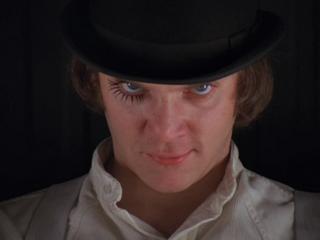
Onto the film. It begins incredibly aggressively, with an intensely red film proclaiming the title and the director and shouting at the audience that this is not a passive film, not a subtle film, and not a pleasant film, a real good opener strengthened by the lack of opening credits, just a straight open onto the Kubrick stare of the protagonist who I'm sure most people have seen, as it is one of the most parodied scenes from the film, possibly because it is the least lude. The end is the same thing, with shocking almost blood red immediately after the end line. This establishes the tone and sets the pace and is really beautiful in its simplicity.

Moving on we see the droogs, one of the many made up terms used throughout the film, up to a good bit of ultra-violence, as they beat and nearly kill a drunk homeless man, following up this wondrous event they have a good old scrap with another gang, leaving their opponents nearly dead from blood loss. This is of course followed up by the good old rape and cripple, as they enter a house dressed in strange masks and Alex, our 'protagonist' for lack of a better word hums to singing in the rain during his rape. Now the only reason he did hum this, was because it was the only thing that actor knew, though it does lend some irony and additional grimness to the scene.

Quite a Contrast
This doesn't go unnoticed by everyone however, and Alex's activities eventually lead to him betrayed by his droogs as well as his parents somewhat, and the system as a whole. There are a number of reasons for this but I believe the scene that truly exemplifies it the best is when Alex goes home and opens a drawer fill of wallets and jewelry and money, and throws in the days takings. He doesn't do it because he needs the money, or because he wants it, he does it because he enjoys it to a sexual level, as demonstrated by the last scene, but we'll come to that when we get to it.

Now how he is betrayed by the system is interesting, because of the way it is presented. Society wants him to be good, that is what the social worker and his parents and the prison system all seek, but there are some, like the lead guard in the film who believe otherwise, and the message of the film  relates to this. Alex's reform is the crux of the second act of the film, and the event that drives the third act. Alex is reformed through the use of subliminal messaging to tell him that violence and sex are bad, repeated through incredibly aggressive imagery to Beethoven's 9th, a beautiful piece of music.

The film delights in the irony of it and the fact that by depriving this villain Alex of all violence they have made him as innocent and defenseless as a lamb unknowingly drifting off to the slaughter. Everything that he had done to the people before is revisited upon him, and eventually it becomes too much. He is tortured by his previous lover, the music of Beethoven, quite possibly the only thing he ever loved as well given his attraction to sex but not to a relationship.

The infamous device
The film ends on a significantly darker note than the original novel, one that could be argued is for stylistic reasons, as well as due to the fact that the copy of the novel that Kubrick read was actually missing the final chapter. Many copies of the novel actually left out the final chapter, as it ended with Alex realizing violence just wasn't as fun as it used to be, and going off to start a family, so a fairly positive note. The film ends with Alex realizing that he has found his love again, and that it actually gives him sexual pleasure to hear the 9th. And on that menacing note, he claims "I was cured all right" and the audience realizes that nothing has really changed.

The theme of powerlessness is always an interesting one in fiction, and dealt with fairly thoroughly in this, though it deals more with power than the lack of it. His droogs become policemen and thus have corrupting power and the ability to control him in his weakened state. His control over them previously was through the threat of violence and actually carrying it out when he believed they needed to be kept in line. Given that is dystopian fiction the overall rulers are also important and corrupt, caring more about winning the next election than anything else, which drives the events with Alex. They believe that an untested treatment may give them an advantage on crime, so immediately use it, and when it fails use it again for the PR boost. It's no different than what most politicians do nowadays however, so carries that perpetual message.

What makes it so effective is the ugliness of the film. Much in the same way as Chainsaw Massacre, the film is not pretty, all nudity is uncomfortable and ugly, and even the theoretically perfect society deals with criminals in a grotesque way, altering their minds to try to prevent crime, maybe even thought-crime going to everyone's favorite dystopian novel. I will say now that it is an effective film in what it seeks to do, to unnerve and to show a terrifying direction the future may go in, just like all dystopian fiction. Give it a watch, but be prepared for the ugliness inherent in the story, and a view on the darker side of humanity.


Sunday, November 27, 2011

Texas Chainsaw Massacre (The good one)


I'll start off by saying this is the 1974 one, no other silly remake or the like. Then I'll say that this is a good film, though it is not a well made film. The cinematography and dialogue are all kind of weird, and when compared to other films, even of the era and the time it just doesn't stand up as well, but the tone of the film, and the way it was made are what contributes to the horror, and what make it such a classic that it can still be watched today and considered good.

So the film starts off by saying it's a true story. The whole film is kind of an attempt to make a film like a documentary, like Blair Witch did so famously in 2001, and as the Coen Brothers said this is what makes the film more realistic, because if people believe it is based off of a true story, they allow for pretty much anything. The story is true in that people were killed, at some point in time, by someone, but all the details and just about everything were changed, so the notice is not one of fact, but one to enhance the fiction.

We have a nice narrator detailing the facts of this "true" account over vague shots of corpses, with flashing in and out to make it unclear. Then we cut to the protagonists of the film, five teenagers who seem fairly normal, if very 70's. After this introduction the crew meets the first psycho of the night, a lovely hitchhiker who upon arriving in their van cuts himself and sets things on fire, this is not appreciated, so they throw him out, though not before he cuts one of the characters, and swears a vague act of revenge in the form of blood on the van.

Then the group heads to the house they were planning to stay at, but the house next door is where the action really starts. Surprisingly one pair of characters is killed off very quickly, with little ceremony, the guy first being smashed in the head, then the girl wandering in to have about the same result. The suddenness of these events is what makes it so surprising, as all deaths in the film, with the notable exception of the leading lady last maybe 10 seconds. This creates the fear, because of the sheer viciousness of the acts which kill these characters, and the speed of them.

The entire film is very dirty, or gritty I guess if you want to go with a more positive word. It is dark, grimy, and has bones almost everyone once the characters reach the house, and doesn't seem to do things too deliberately. It is almost the opposite of a Kubrick or a Hitchcock, or even a Wes Craven horror because of how sudden, grim, and dirty all the actions are, it looks like none of it was planned as opposed to their films where it appears everything was.

The other note about the film is that it is very loud in general, from the sounds of a chainsaw from constant shreaking in the third act, but it's the moments of silence, where all you can hear is the chirping of the crickets or the  beginnings of the music that make it truly effective as a horror. There is nothing really comic here, just a pathetic bunch of crazies doing crazy things. On the whole it is effective in doing what it is trying to do, a new kind of horror which doesn't rely strictly on shocks or gore, but on the whole combination of grime and blood and terror to create this whole experience.

On the whole, it's a bloody good time, though it features surprisingly little blood.

Saturday, November 5, 2011

No Country For Old Men

,
This is actually probably my favorite film of the decade, so pardon me if it's a bit biased After watching NCFOM for the umpteenth time I finally realized what it was about. It wasn't just about death, or the senseless violence that has become so prevalent in society, no the main issue explored in the film is the generation gap. Out with the old, in with the new, sometimes in the most violent way possible.

First a brief summary, a Vietnam vet but otherwise everyman finds some money, this money belongs to Mexican gangsters who pursue him throughout Texas. The main antagonist here is the kindly fellow on the right, Anton Chigurh. Following this chase is an old sheriff, just one day from retirement, who surprisingly doesn't get killed. With the conclusion the film is almost an anti-movie, with the main character murdered off screen, the villain getting away essentially scot free, and the narrator just getting tired of it all, and quitting.

This is all related to the initial theme, that of the difference between the generations. One scene near the end seems almost like a non-sequitur when taken out of context, where the sheriff goes to a retired lawman's house and hears a story about his uncle getting executed on a porch in the early 1900s. This scene actually clearly shows to the sheriff that violence has always been around, and that nostalgia for days past will not help with today. The old days were not as good as we have come to believe. But this is tangential to the main point; for society to function the new must replace the old.

Throughout the film the old are slowly killed off, or give up on contributing to society. The two youngish characters who are killed where Vietnam veterans, and had thus experienced much more hardship than a typical person of their age, so were mentally old/tired. When the sheriff discusses his problem, Anton Chigurh, and the protagonist's death with another sheriff they have what may be considered a cliche rant about kids these days, with people with "green hair walking down main street." They realize that their time has come, especially the narrator sheriff, who decides that is is time to retire, and though the title is not dropped, it is heavily implied. Once the old have gone it is time for the new generation to come and show what they can do.

During the film there are only two sequences with kids, both featuring them coming into a scene of immense violence, and their different reactions. The first is a group of teens coming back from drinking in Mexico, and encountering the protagonist injured from a shootout. One of them can not accept this, and keeps repeating "Were you in a car accident?" much to the annoyance of his friends, who demand money in exchange for helping the protagonist. The inherent greed shows that the generation to come, and since this was set in the 80s they would be in their 30s now, can be intensely greedy, leeching off the troubles of others and exploiting the disadvantaged. This could easily be a comment about the current political and economical situation, and was extremely topical in the time it was produced, 2007.

This stands at a contrast to the second group of kids. Anton Chigurh has just been in a car accident, and two kids come up on their bikes, offering help. When asked for a shirt one of them gives it freely, and even declines payment when it is offered. The Coen's seek to show that there is hope for for this next generation, and that not everyone is the same, some offer the selfless charity that is also necessary for society to function. The film is about the new replacing the old, as well as the assurance that though there are bad people in this new generation there should be no fear, as that is the way it has always been. There has always been violence, and there has always been selfish people exploiting others, just as there has always been human charity and those who will pursue what is right despite it not being easy.

In the end there will always be those selfish and evil people, just as there will always be selfless and good people, and the constant struggle between generations is on a whole unnecessary, because just as each generation has its changes it on a whole is always the same.

Tuesday, October 25, 2011

A Double Feature of Horror

Two movies came out in the 80's, both great horror films, though they are only related tangentially. The first of these films was 1981's The Evil Dead, a relatively unknown film compared to its sequels, specifically 1992's Army of Darkness. Both feature the man who could kill with his chin, Bruce Campbell. But neither of these films really compared to the success that was 1984's Nightmare on Elm Street, a horror classic that actually built up tension as well as delivering plenty of gore. Now when I said these films were just a little bit related I mean in one of Nightmare's scenes The Evil Dead is playing on the TV, which was then referenced with a Freddy Kreuger glove in Evil Dead 2, quite a cool legacy.

First let's look at Evil Dead, the quintessential B horror film. The movie starts out creepy enough, a good location of an abandoned cabin the woods with dripping pipes and an evil history of the cabin. There's some decent camera work and all that to create a fairly good atmosphere, then shit gets really crazy.

First we have the tree rape scene. I will say nothing more, because anything else is extraneous, it is truly horrifying. Then when the girl is recovered from this traumatic experience she becomes a weird zombie thing and is trapped in the cellar, though not before biting one of the main cast. One of the things I really liked about the film is that Bruce Campbell is not the obvious protagonist, at least not a first, he seems more like the guy who dies in self sacrifice last or something.

The others die or get zombified relatively quickly after the event, and then it just becomes a matter of how much liquid they can spray on our hero, as well as just how much violence they can fit in, while still maintaining the eensiest bit of horror and tension. It's pretty much all gone though, especially once they get to the things just attacking from every direction, including a zombie stabbing a character with a pencil, it's just kind of silly.

That's the movie's strength though, and especially where it differs from Nightmare. It embraces the silliness, and the gore and all that and becomes a much better movie and series for it, unlike some of the later Nightmare sequels, which turn the former terrifying antagonist into a wisecracking joke of a villain.

Talking about Nightmare it is a genuinely good horror film which features Johnny Depp (In a first role) being completely obliterated in a geyser of blood. The way the film builds tension is like all the great ones, by not showing the villain, always cloaked in shadows and unknown until the climax of the film he was all the scarier for it.

I mean sure, nowadays everyone knows Freddy Kreuger, something the remake took for granted and was much the worse for it, but then it was such an effective scare with someone targeting us when we are at our weakest, asleep. Using nightmares as a tool added an extra depth to the scare, because by having nightmares about the film, an intended consequence, it added more impact to them because it was possible you would die in real life. Not actually, but you know.

Anyway I don't have an enormous amount to say about either of these films, other than to recommend them to all lovers of horror and thriller too, and especially the connoisseurs which prefer something a little dated, and with just that tad bit of humor, though not too exaggerated like Nightmare 4-8.

Tuesday, October 18, 2011

May (2002)

Before I delve into the film, let me detail why it has been so long since I've updated. I suppose it's a combination of factors, as it so often is, primarily just how down I was feeling previous to a camp last week. Another thing is just how much work I had to procrastinate, which is always a strain. Then finally there is just the simple lack of enthusiasm, but honestly if anyone reads this and gets some enjoyment I will feel happy, so without further ado I present May, a film which was incorrectly advertised.

The film starts off fairly innocently, well that's not entirely true. The film begins with the protagonist stabbing herself with scissors, then quickly cuts to her and her mother finding a doll. Then the real plot begins, with the titular character, May, working at a veterinary hospital with a fairly weird co-worker and a boss who doesn't respect her.

We see May's obsession with a man as well as her unhealthy collection of dolls, but the movie is not really horror at this point, and isn't really until the last 20 minutes. That is why it was advertised wrong, with the poster and the trailer and everything clearly stating it was a horror, when it should have been advertised as a romantic comedy with a twist ending, which would have added much more impact.

I digress however, and complaining about it now won't exactly change anything. The actors are all fairly decent, with the suitably awkward main character really carrying the show (She also played Carrie in the ill fated remake). The film received moderate critical acclaim, though some critics really despised it, and audiences never watched it, so it remained largely unnoticed, though its developed a small cult following.

Overall I recommend seeing it, though don't go in expecting a masterpiece, it surely isn't. Compared to other horror films of the time however, it was some what of a breath of fresh air, adding an interesting subversion to the genre, and delivering scares without just bump frights.

Well I hope to write more movie stuff over the next couple weeks, mainly as a way of procrastinating and taking my mind off all those things in the world which are just a bit too big.

Sunday, May 1, 2011

Babbity Rabbity and the Time Warp


Donnie Darko

This is not a review, but a discussion, a score at the end will not be given, but I will look at what makes a film, and why this makes it so. This is entirely made out of opinions, and wikipedian facts will not get in the way of the feelings of my gut. Without any further ado, what makes it a film worth watching.

Donnie Darko is a romantic film, dealing with the issues of predestination as well as far less important issues like how the Smurfs live without dicks. This is all wrapped up in the cover of a psychological thriller, but given Frank's line "Why are you wearing that stupid man suit" it would seem that appearances are not nearly as important as the actual substance behind it. This results in a cult classic of a film, much beloved by audiences who never saw it.

The music used in the film varies a huge amount, just like the content, with frequent switches between the insane drama of a paranoid schizophrenic and the exploits of an ordinary teenage boy. The most memorable image in the film is one iconic to its persona, the rabbit, Frank. This image will certainly outlast the film it comes from, even though it is intelligent beyond what many films of the decade are. But that damn bunny will haunt the dreams and nightmares of a generation, much like the clown in It did for the previous. Incidentally the mother in the film is reading the novel of It, a nice little pop culture shout out, one of many in the film.

But the real issue dealt with is that of free will, and predestination, and what the hell does God, or a god have to do with any of it. Donnie plays the role of cynic, insane, but he knows it. The rest of the world appears relatively sane, but underneath that bunny suit lies only pain and death. This is the message, if, given the opportunity, you would sacrifice yourself, and the known, for an unknown never to be known by you. This is key to the romance between Donnie and Gretchen, as there is never a perfect option given, one of them has to die.

The seinfeldian conservations occurring at the earlier parts of the film stand at an utter contrast to the insanity of the end as the deadline draws ever closer. 28 days, 6 hours, 42 minutes, 12 seconds. An insignificant number for a significant film. All it really adds up to is 82. The multilayered story involving a short story studied not quite detailing Donnie's past adventures, and a book hinted to explain everything explaining nothing to the audience. The knowledge of misinformation is key to the discussion of predestination, if we know are destinies and follow them, are we any different than the ignorant masses who don't know and follow them still? This is never fully answered, as nothing really is, but encourages thinking, something woefully devoid in many films.

And allow me to leave on a positive note, not involving the death of a good portion of a family, nor a love, nor a friend. But a few simple words which affect know one, meaning nothing and yet oh so very much. It's all about the cellar door. A couple of words that form a couplet, and which describe a gateway to a new place, or just a few words which sound mighty nice. So the portal opens, and the portal closes, and at the end all you're really left with is a cellar door.

Score: One fucked up bunny, one fucked up kid, and one fucked up life. Best romantic comedy of the decade.