Search This Blog

Showing posts with label Romance. Show all posts

Monday, January 14, 2013

Wallflower


The Perks of Being A Wallflower is a wonderful movie. I'm not just saying that because it has Emma Watson in it either, though she is amazing in it. I'm saying it because it is a genuinely good bildungsroman about high-school and growing up and all that complicated shit that occupies life. I went in expecting something comparative to The Dreamers, about a kid who meets up with two eccentric people older than him and learns to live life with them, but I got something different, something I hate to say better but definitely different.

The film is a traditional teen movie in that it does not have a plot, and takes place over the period of about a year, just showing normal life with theoretically 'normal' people. In all honestly it doesn't differ too much from the standard formula, though it has some deeper relationships than most of the crap out there. It is also a dark movie. It's not dark throughout, and there are many moments of comedy and just enjoying life but they often transition, rather abruptly, into moments of very serious discussion, like rape, abuse, and suicide. These are issues that pervade life but are often not talked about, but with an anthology of a year like this and many other films they can be brought up and discussed.

The film follows what seems to be a normal freshman boy, though he is significantly older than his peers because he was held back several years. He is bullied because he likes reading I guess, and often ends up alone in the lunchroom reading his books. To me it seems, not unbelievable, but a little cliche to have someone like this in this day and age; however the film is set in the early 90's, when it was more of the style. I guess it works okay, and doesn't last too long, but the establishing bits don't need to be quite so long.

Anyway we are introduced to the garish and flamboyant Patrick fairly early, who is also mocked and insulted, repeatably called Nothing by others at his school because of what a teacher said on the first day. He is the stepbrother of Sam, played by Emma Watson. Sam used to be a bit of a whore as she admits, though not in those words. She would have sex with people just because she could, and frequently abused her sexuality to get what she wanted. Unlike most films in Wallflower she is a protagonist, not necessarily giving up her life but trying to do something a little different.

The main play of the film is the dynamic between our shy, innocent, loner main character and these extroverts who like to shout out to the world who they are. At one point this is almost literal, as Sam stands atop a moving truck and shows herself to the world, awash in music and magic. Patrick slowly becomes closer to this, becoming indoctrinated to their way of life, even playing Rocky at one of the Rocky Horror Picture Show productions, as opposed to his earlier awkwardness watching the show.

This is not a new story, nor is it told in a particularly unique way but there is something that just grabs me personally about it. It reminds me more of Donnie Darko than anything else, though the delusions of the main character are much more grounded in reality, seeing flashbacks of his Aunt who was killed in a car crash and was later revealed to have molested him putting her actions and his love for her in an entirely different light. It might be these moments of light and dark that permeate all of the film that make it something more than the sum of its components, with all the shit, good and bad, that happens in life all lumped together and thrown at the audience.

Overall the film manages to stay true to its audience while showing that bad things happen, and when they do the only real thing to do is to get up and keep going. In one tragic scene at the end the protagonist, one could possibly call him eponymous, tries to commit suicide as all of his friends are going off to college and he will be left alone at high-school, counting down the days until he can go off and do something on his own. This is similar to many people's experiences with it, though magnified as films tend to do, because there is nothing more human than people, and their actions and beliefs and sheer presence is often enough to make all the difference, as shown by a wonderful scene at the end where he finally rides free in the truck like Sam, finally in the world of Do-What-You-Will, and no longer a wallflower, but infinite. That metaphor never really goes anywhere but the point stands, he transforms.


Monday, December 10, 2012

An Invisible Place


Ghost World is not a unique movie. It does not try to accomplish much, it is not a grand scope, and while it has some decent actors and performances it shouldn't really be anything that special, but I really, really enjoyed it. In my mind it is Juno but done right, and I know it was made about 6 years before Juno so the comparison is not really relevant I just feel like it works so much better. There are a few similar elements but they are two different movies, though both star teenagers making difficult teenage decisions.

Life isn't easy for these first world people who live off plenty of food and have happy homes, they have relationship problems with their friends and family and no one seems to really know what romance is about. Enid and Rebecca are two fairly run of the mill outsiders who are basically hipsters before the word existed, loving to live at the edge, thriving on being non-conformist. They play pranks and do things which they think are random enough to attract attention. These are all negative qualities, and theoretically the viewer should hate them for these qualities, but they are oddly endearing. Enid is so confused by life and scared that we really identify with her, and the feelings of rejection and again fear held by Rebecca echo throughout life.

These characters are defined by the script, as the cinematography of the film is nothing special, just fairly typical style of the 2000's, many extended shots on seemingly unimportant details, examinations of rooms, and in general more focus on dialogue than anything else. One unique feature of the film is that it leaves almost nothing resolved at the end. It is not that it doesn't have an ending, it's just that the character's stories are not resolved, and life goes on for a bunch of clueless people. Enid gets on a bus that shouldn't exist at the end of the film and goes off to an unknown place, still unsure of herself but sure that she doesn't want to live the way she did.

The film chronicles the story of Enid and Rebecca's summer approximately, though no definite time-frame is really established. Enid plays a prank on a man named Seymour played by Steve Buscemi. The prank is really one of the cruelest moments of the film as she falsely returns a personal ad from the paper setting him up on a non-existent date. He comes into the shop and they watch him. Slowly it dawns on the pair that what they have done is cruel and Enid develops a fascination with him, going to where he lives and trying to find out what kind of person places that kind of ad.

In the end it is a character study on both of the protagonists, and their relationships with others. Around the second act Rebecca especially loses her screen time and is replaced by Seymour, directly showing the audience how out of touch Enid is becoming with the rest of reality. In the film a romance is hinted at between Seymour and Enid that becomes official about midway through the third act but it is more of fumbling in the dark than anything else. Neither knows exactly what to do about it given the large age difference and culture difference, and Enid especially doesn't know what to do as she has agreed not to go to college and her father is considering getting remarried changing everything she thought she knew.

With every end there is a new beginning and that is what the film ends with, the promise of more, of something that happens later that the audience does not know about and can't for it to be a fitting conclusion. Life does not simply stop in the middle, but the film does, because there is simply too much for a single film to cover, life is complicated and long and confusing, and the film shows that with a non-ending that still seems like a conclusion. One of the only sure things is that Enid will no longer be involved with the other characters, as for where they go or what they do the audience is unsure, but can make up their own stories.

In the end all movies about romance are just stories that will end one day, because very few truly last forever. That is why it is important to know when to end, when to stop the story and let everyone live happily ever after. If things go on too long they always end in death, Ghost Story is about people, and how they all seem to exist in their own little places, their own worlds, but no man is an island, and every decision affects others, often inadvertently. Life is all interconnected, and so are all the people in it.

Monday, February 6, 2012

You Can (Not) Advance

Not the poster for a normal film

In 1997 Hideaki Anno was really depressed, like had serious issues, and he put them all on display in his magnum opus, Neon Genesis Evangelion. The ending, the last two episodes, are considered an enormous fuck you to his fans and deciphering just what was meant by them is a place only the priests of the Great Old Ones go. The movies he released afterwards didn't help a bit, and made a confusing ending into a downer ending, which really doesn't help anything. Then we flash forward ten years, Anno is happily married and through counseling amongst other things has gotten over his depression, and seeks to remake the series that made him so famous, this time without the angst.

This led to the first film, a fairly standard anime remake, featuring mostly the same enemies and situations and characters, albeit with more badass and higher production values. That was You Are (Not) Alone, this is not that film. This is the film that goes batshit insane midway through and gets worse for the rest of the film, and brings about the end of the world only halfway through the quadrilogy. This is the film that brought soundtrack dissonance to a perfect art, even more so than the original series. It is also the film about true love and the destruction that it can bring, and in that sense it is a tragic romance, like Romeo and Juliet, but with giant robots.

The film begins with surprisingly passable English, excluding the voice-work from one of the main characters, which sounds more garbled than a whale song. We see the destruction of the notably absent third angel, essentially giant robots from outer space that seek to annihilate humanity through a variety of means. We are also introduced to the blood knight Mari, who destroys the angel at the cost of her own Eva, which in all likelihood cost billions if not trillions of dollars, real good job. Now there are a lot of Christian references and imagery throughout the film, including the now famous cross explosions, but even with all the discussion of God and what humanity is building, essentially trying to create a new God, it doesn't dwell on these issues with any real depth.
Crosses are still cool right?
There are any number of reasons for this, primarily that no one in the series can really agree on what they're trying to do, given that everyone is trying to run Xanatos Gambits (TvTropes if you don't get the reference) but mostly they seem to fail, because they rely everything going according to plan, and it just never does. There's also the fact that when you make a film like this you really have to concentrate on one major idea or ideal otherwise it tends to get cluttered and confused, and then you get a clusterfuck of philosophy like the ending of the series and no one wants that. So for the film Anno went with the idea of love, one so simple and so complex that it works perfectly for an anime which deconstructs that which it seeks to emulate.

So in the film we have Shinji, our protagonist who's only real goal in life is to actually have his father appreciate him. He has fallen in love with Rei, who is his father's weird daughter/wife/genetic experiment thing and may actually have elements of his mother's soul in her, it's not entirely clear how close the films follow the series. The new German girl introduced as well, Asuka, has a crush that she will never admit on Shinji, and they grow close throughout the film, until he is forced to near fatally wound her, which kind of changes the nature of any relationship. In terms of parental love, well it's essentially non-existent or abusive in Shinji's case. Now all the characters suffer some sort of psychological dysfunction, though none so much as the original, in that they might be able to function in a normal society, instead of going fetal position in the corner at the thought of people.


So love is the thing which causes the end of the world. Quick summation of plot up until the end, there are angels, and this one angel is a bad motherfucker, exploding pretty much all the defenses and waltzing on through to the base of the base, which contains Adam, the basis for all Angels, and if they were to contact in all likelihood it would be the end of the world. First he tanks a huge amount of damage from a 'beast' mode Eva unit 02, which is basically a werewolf form of a giant robot. Which is approximately as terrifying as it sounds. And yet, it doesn't work, it rips and tears and just about dies for it, then Rei runs in with a fucking nuke mine and shoves it in at point blank with an enormous rocket attached.

The Rainbow shield is far too powerful
 So everyone has just about given up hope, with two robots down and the angel heading right towards Armageddon, but then Shinji comes to save the day, not for the world, not for his father, but for Rei. His first action which is truly unique to him is his attempt to save the only person he may have ever loved. In the series he actually had to kill the only person who ever loved him. He does this by breaking through human limitations and basically saying fuck you physics, defying all previous badass attempts by himself and others by shrugging off attacks which had previously lacerated. He then reaches through time and space to retrieve Rei, who had been eaten by the angel previously, finally earning his happy ending.

But I mentioned something about the world ending before didn't I? Yes well it turns out that transcending mortal limits means ascending to godhood, or something very much like that, resulting in an explosion or something that will wipe out all life on earth. Real nice kid, ending the world and all that, but as previously stated he doesn't care what happens, to the world or anybody, he just wants Rei back, which is quite a nice sentiment, but then it leads to the natural logic that the power of love brings about the end of the world, which is a bit of a different matter from some other works, say Harry Potter. So what kind of theme are we going for here Anno? Does true love lead to disaster? You'd think with his wife and kids he'd have something different to say, but with just this film it certainly looks like it.


Then the kicker happens. The only character who ever said I love you to Shinji in the original series descends down from the moon and impales him with some sort of lance, preventing the immediate end of the world, though quite possibly also killing him and Rei. The ending is bittersweet in many ways, and that is in part due to the fact that it is only half-way done, with a third entry likely coming out this year. In the end it is a good entry in a series of films, but as a standalone does not work at all in terms of resolution, and not in the Sopranos way of no resolution.

Gory, but less so than much of the scene.
It is a better ending than traditional Gainax bullshit, but it's still pretty up there in terms of normal endings. As for the rest of the film well, it is incredibly violent, especially when Unit 01 attacks unit 03, there are organs the size of large buildings flying off, not to mention enough gore to cover most of Tokyo, quite literally.It forms a rainbow at one point. The image to the right is just as 01 truly finishes off 03, though not before he takes a huge bite out of the pod that Asuka resides in, seemingly determining her fate. The worst part though is that Shinji has to sit there, unable to control it, unable to stop it, forced to watch as what was once his slowly destroys one of his best friends. 


On the happy scale, the film starts off practically idyllic, with Gendo even agreeing to see his son, Shinji, for dinner. Actively working towards a happy relationship? Impossible! No, there are attempts at friendship, parental relationships, and even love, then they all get squashed in one scene, that one just above there, with the giant robot head that goes boom. It is Evangelion, so a happy ending couldn't really be assumed, but it can be hoped for, and you never know, maybe Shinji will actually find happiness this time, instead of suicidal manic depression resulting in a deep regression into fantasy. 


The end result is a film that is decent watching on its own, with good action scenes, a good budget so quality animation, and semi-likable characters, but without context from the previous film, and even from seeing the original series it really loses something, which is a problem. Another problem is the ending is simply a set-up for a sequel, which just kind of pisses me off, because damn it if you are unsure of when or even if there will be a conclusion don't set up for one. I'd say see it, but preferably get some context first, because the plot will mean little to nothing without it.

Monday, January 23, 2012

Eyes Wide Shut

Some of Cruise's best acting lies in that mask
Often we miss what is right in front of us, can't see what is right in front of us, or just plain don't want to. The world outside is scary, we prefer to stay inside away from the strange and terrifying. Yet, that curiosity, you know, the one that killed the cat, it gets the best of us and we seek to know that which they say we shouldn't. That is not what this film is about, at least not at its heart, and it is a very heartfelt film. Like all of Kubrick's films there is an almost psychotic attention to detail, but it is shown differently in this film. This film is rough, in much the same was Chainsaw Massacre is, it does not have the perfectly manicured shots of 2001, or the slow deliberate horror that was the Shining, it has its own identity, and seeks to define that thoroughly from everything to the lead actors to the music to the colors. At the very core of its being, it's about fucking.

That's not entirely fair, nor descriptive, but sums up many of the scenes, in its rudeness and abruptness, and strips it down bare, to what is left when you film people like he did. The last scene is succinct but also incredibly long-winded, and then it ends. The film, the mystery, all of it ends in such an abrupt way the audience is left with mouths open-mouthed at the sheer audacity of it, and it could be compared to the Sopranos in terms of resolving what happens. We're left with an obscene term, with the rhetorical question, "Well you know what we have to do now. Fuck." That's it, roll end titles. The ending is not the only ploy that Kubrick plays however, only one of many in his masterful manipulation. Let's go back to the beginning, it is always best to start there.

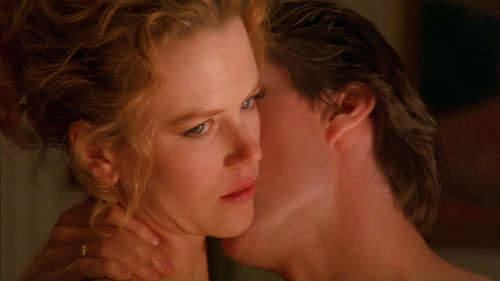
First. Quick. Reverse text title, director, actors. Done. Nicole Kidman's naked back. Done. That is the end of the eroticism in the film, none of the nudity is portrayed as such, and given the circumstances it is often simply revealing of the characters, bared naked not simply nude. I'll compare it to the Dreamers for simplicity, since both featured nudity fairly heavily, but neither was anywhere near pornography, no matter what detractors may say, because the sex or nudity is far beyond the point, and is only used as a tool, not an end. Next the film shows Tom Cruise and Kidman going about their daily lives, dressing up for a fancy party, they engage in what is routine, the first sign that something is not quite right.

I don't want to reference the title but...
I should note the setting now, it's Christmas time. Boy do directors love using Christmas for the irony they can get out of it, and also as a comment on the culture. Other notable films set at Christmas: Brazil, Die Hard, Batman Returns. Cruise is given a number of gifts throughout the film, though I don't think any were really selflessly given, or true gifts. He however sheds money like there is no tomorrow, and at a point he thought that was possible. It's an interesting note about gifts as a whole, one which is not really looked at a lot, in that people who think they have nothing left are willing to give everything.

Back to the plot, the young couple go to a big extravagant proper party, a contrast to the depraved orgy that goes on later, and both flirt with affair, but neither really looks like they might go through with it, because no matter what their marriage is, it is stable, and something they want to keep alive. Unfortunately when drunk Kidman reveals that she imagined having an affair while they had sex, this infuriates Cruise and he leaves to wander the streets. This is where he eventually discovers the masked party the film is famous for, and realizes just how fucked up the city can be. In many ways his character reminds me of the eponymous character from American Psycho, but he never goes crazy, something I was actually looking forward to but oh well.

He is well dressed, and presents himself well, as well as dealing with some of the seedy underbelly, prostitutes and orgies, but I suppose the real difference is control. The character from American Psycho is totally in control of his life/fantasy, and lives it with this in mind, Cruise's character, really isn't. When he seeks explanation he finds only confusion, when he tries to understand he comes close to getting his family hurt. He has no control, and seeks to reconcile this throughout the entire film, and is actually unsuccessful. In the end he is simply a cog in the machine, a doctor who determines how people live and die everyday, but who has no real control over the events that happen around him, one of those ironies that live simply loves to deal out. Though they are so rarely appreciated.

Irony thy name is Dream
I suppose the film is a romance, if one wants to go strictly by genres, but the female lead has some important scenes for the first half hour, then maybe the last 15 minutes, leaving her absent for about 2/3 of the film, and the romance is pretty crappy if that is what you're looking for, a sappy love story. It also fails if you're looking for sophomoric porn, but I doubt many people go into a Kubrick film looking for that. It's a noir film where nothing is revealed, and the mystery may not even be real. Wikipedia goes with drama, the archetypical genre, though going by archaic definitions we could call it a comedy, based off the sort of happy ending. Hell out of all the films I've seen recently it has the happiest ending, one where no one important died, just a lone druggy that no one cared about but who was the only character who cared about the protagonist. Now I'm sad.

The film looks at all the evils in society, and it scoffs. It looks at the elites with their strange doings and politely asks not to question, because there is no question worth asking. It looks at the nature of economy and the way humans contribute to it, and says do whatever, because the world will not change by your will. It takes a definite stance on society, one neither inherently pessimistic nor optimistic, it simply is. The film is about life, which simply is, it begins and ends when it does, and there is no point questioning it when it does. That's not to say that questioning shouldn't be done, it just rarely helps to ask the world why, because any answer you get will be wholly unsatisfactory, and likely from  a crazy person walking past. The world is full of crazies who demand things from the air, or the sky, but doesn't that make the crazies normal?

Anyway like all of Kubrick's it is masterfully directed with a unique tone and message, and a unique way of showing it off, showing all the ruins of society at odds with the posh parties and elements of the elite which stay with that 1%. I suppose it might be more relevant now with the occupy movement, and it has been looked upon in a more positive light lately, as it should be. Fucking brilliant is the final conclusion, with the added note that for some strange reason the mask the Cruise wears terrifies me more than anything from the Exorcist. Just look into its soulless eyes and say you are not staring into the depths of Satan's Soul.


Tuesday, January 17, 2012

The Dreamers

An important scene about love
The Dreamers is a strange film about revolutions, both sexual and political, and one could say it is a bildungsroman, though in a very non-traditional sense. It follows the story of a teenage American boy who has recently moved to Paris who is attempting to fit in amongst some fellow cinephiles and ends up moving in with a brother in a sister, who have an incestuous relationship, this is incredibly awkward until he directly addresses it, then has a passionate love with the sister, though becomes embroiled in something much bigger than himself, the revolution talked about throughout the entire film, both metaphorically and literally. It is set in 1968, which really is the perfect time for the piece, and it is very much a period piece.

First a historical note. The film is set during the beginnings of one of the biggest protests ever. Over 11 million french people were on protest at one point, almost one quarter of the country. These riots involved peaceful demonstrations but quite quickly evolved into direct violence, and almost a sort of anarchy. It ended the contemporary government's reign, so it was effective in that sense, and also prefixed a lot of social changes that were so prevalent during the 60's. The most important for this film was the sexual revolution, as an era of freedom and expression began, and created the culture that is so relevant today.

The film begins with a fairly catchy tune, evocative of much of the soundtrack. The soundtrack is actually concurrent with the era, so it is all 1968 or before, which creates a very unique feel to the film, which is further evoked by the cars and technology of the era. The opening credits are set to a background image of the Eiffel Tower, which is inherently a symbol of change. We're then introduced to our protagonist and narrator, who is fairly likable even if I don't remember his name. He walks to a cinema built in a metaphorical palace, which looks like a truly magical place, fairy-tale like, which is what the film tries to evoke through much of the second and third acts.

Not my style, but still damn pretty
So at this he meets the initially domineering and dangerous Isabel in a beret, like Che Guevara, and then we see her in chains protesting the shutting down of the cinema. It is there that she invites him home, and we begin the journey down the rabbit hole, but we don't really see how deep it goes until the parents leave. But the film is not strictly about revolution against the parents, merely how without parents/authorities revolution is inevitable. When Isabel contemplates suicide at the end because her parents have found out about her relationship with her brother we realize how powerful this parental relationship can be, and what it can do to people to have their parents realize who they truly are, again a metaphor for government. The film is also about film.

When I say that I mean it is a tribute to an era of film-making, and music, and philosophy. It knows the time better than many pieces from the same time. In a way it can be compared to Tarantino's films, in that he knows the period he is referencing, and with his encyclopedic knowledge of films it shows. The difference here is Tarantino's references are implicit, and the Dreamers are explicit. The Dreamers shows the films it is referencing, names them, shows how the characters know them, and though more appreciation is gained for having watched the films a casual viewer, not that there really are any with this film, still can understand them. Tarantino's are more take it or leave it, if you get it good, if you don't well it's brief and unimportant. Different style of film-making, neither implicitly better or worse.

When I say it's a tribute to the philosophy of the time I mean it's about the revolutionaries that became so popular in the 60's, due in part to the Vietnam war and disillusionment and also because of the media which influenced people so. Films like Psycho that sought to break the social norms, and acknowledge the madness that lies outside, and others like To Kill a Mockingbird showing the racial injustices prevalent at the time and how god damn ubiquitous they were. These films revolted in small ways, and the riots in Paris at the time were simply a microcosm of what was happening around the world. The film shows this perfectly through its explicit imagery, through its dream-like state and the refusal to acknowledge the outside world, the issues of appearance versus reality and all that jazz.

No penises here
Now to talk about why the film got an NC-17 rating. It has full frontal nudity, like a lot. If you're offended by that, well this is not the film for you. It also has explicit masturbation by a male, incest in everything but the most technical sense, and several sex scenes, including one which is about five minutes long. There are a number of reasons for this, notably with sexual revolution as a predominant theme it had to include some nudity, because otherwise the point would be neutered, it helps to define the characters more than without it, and it's just the director's way. Just as Tarantino uses excessive violence, Bertolucci uses excessive sex. Both uses of the word excessive here are simply compared to the norm, and they really are not excessive to me, but simply to the censors.

The director, Betolucci, clearly loves the subject matter, and it is evident in all the choices made about the film. The philosophy in the film, evidenced by several different characters in different ways seems like it was someone's personal philosophy, about how every element of the universe works together to form a wholly together whole. A nice optimistic idea in a sense. Interestingly the film ends on quite a sorrow note, or even no note at all given how open the ending is. The brother and sister go off together, ignoring the protagonist's cry to break apart and to live their own lives. The film actually ends on a small fire burning, with police vans in the back after all the riot cops have run forward to intercept the virtual army of protestors.
On the whole I'm not sure if it is a comedy or a tragedy, using the classical terms. The ending is not wholly ambiguous, but leaves enough up to question, about the fates of the main characters as well as that of Paris as a whole. It is a lot like reality in that way, but only really the ending and beginning are. The rest of the film is so unreal, that it is less realistic than the likes of Star Wars, or for something more grounded in reality Donnie Darko. Films which thrive on their fictitious nature are more real than a film rooted so firmly in reality in terms of setting, but is so far apart in terms of characters and style. As I said, I don't know what to think, I'd say give it a watch if you're fine with explicit sex scenes, but be ready for something very unique, an entity unto itself.

I'm actually not sure if I'm done with this one, I feel like there is more to say on that theme of appearance versus reality, so stay tuned for a second part, maybe.

To add some class