Search This Blog

Showing posts with label Drama. Show all posts

Saturday, February 18, 2012

White Noise 2: The Light

Now I would normally never watch something like this, even with someone like Nathan Fillion in the lead. It's a sequel to a crappy 2000's horror film, there is no way it can be decent right? What if it was essentially a completely different movie, with some kind of similar supernatural phenomena as the only ties? It basically distances itself as much from the awful original and becomes something definitely above average. With decent leads, a decent script, and a fairly original idea it definitely results in a watchable film, though it is dragged down somewhat by the style of film-making that was so popular in the mid 2000's, which is difficult to describe but is kind of annoying, something about the camera angles or colors or something.

It begins with the murder of the protagonist's wife and son by some guy for seemingly no reason, who then promptly shoots himself in the face. Another thing I like about the film is there is no real big twist or anything like that, Bruce Willis was not dead the whole time or anything, though there is a slow revelation about what exactly is happening. In the end it's not perfectly explained either, no scientific or voodoo explicit discussion, kind of similar to the Exorcist in that way. He sees dead people, and can also see people about to die, which would be an awful super power, there is a comment about it in the film, and it really would suck, knowing all these people are about to die, and being unable to prevent it.

It also has similarities to Dead Like Me, with the reapers. No one can save these people, it is the whole hourglass thing, once the sand runs down your time is up, and extra time does not end well for anyone, often resulting in the deaths of many more. Nathan makes a good tragic hero, in that you know it'll end badly, because there are so many similarities between him and the murderer of his wife and son that even though the film draws the comparison numerous times it is really unnecessary, one of the small problems with the film is that it ditches subtlety fairly early on, though there are still some cool background images of the anti-cross thing.

I can see why people like the film, because the whole idea behind is interesting, if kind of a mash up of the Sixth Sense and Dead Like Me, with some diner scenes that gave me some weird Pulp Fiction vibes, though without Samuel L. Jackson. Now I guess there are a few other minor complaints, like the romance between the two leads up there in the picture seems fairly forced, with her falling head over heels for him upon meeting him, in the position of her as his nurse. Also this thing is classed as a horror because it has a bunch of jump scares, all the same dead people jump out unexpectedly!  A little surprising the first time, though none of the like 10 times afterwards. Decent makeup on the dead guys though, so that looks fairly decent, as does all the CGI and few other practical effects in the film. It still has the weird blue tint that films love so much, but it is easily ignorable.

I enjoyed the film despite the little missteps, definitely very unexpected due to the nature of sequels. I suppose Nathan Fillian is in a lot of these smaller projects, and Joss Whedon's stuff, and he generally does decent work, so maybe it shouldn't be so surprising. The ending worked for what it was, and wasn't even that bitter sweet, even with the main character's death. In summation since this will just be a quickie, the film has good ideas, a good cast, and is in general a shitty horror, but a decent movie otherwise, with reminders of better films but enough good in it to stand on its own.

Monday, February 6, 2012

You Can (Not) Advance

Not the poster for a normal film

In 1997 Hideaki Anno was really depressed, like had serious issues, and he put them all on display in his magnum opus, Neon Genesis Evangelion. The ending, the last two episodes, are considered an enormous fuck you to his fans and deciphering just what was meant by them is a place only the priests of the Great Old Ones go. The movies he released afterwards didn't help a bit, and made a confusing ending into a downer ending, which really doesn't help anything. Then we flash forward ten years, Anno is happily married and through counseling amongst other things has gotten over his depression, and seeks to remake the series that made him so famous, this time without the angst.

This led to the first film, a fairly standard anime remake, featuring mostly the same enemies and situations and characters, albeit with more badass and higher production values. That was You Are (Not) Alone, this is not that film. This is the film that goes batshit insane midway through and gets worse for the rest of the film, and brings about the end of the world only halfway through the quadrilogy. This is the film that brought soundtrack dissonance to a perfect art, even more so than the original series. It is also the film about true love and the destruction that it can bring, and in that sense it is a tragic romance, like Romeo and Juliet, but with giant robots.

The film begins with surprisingly passable English, excluding the voice-work from one of the main characters, which sounds more garbled than a whale song. We see the destruction of the notably absent third angel, essentially giant robots from outer space that seek to annihilate humanity through a variety of means. We are also introduced to the blood knight Mari, who destroys the angel at the cost of her own Eva, which in all likelihood cost billions if not trillions of dollars, real good job. Now there are a lot of Christian references and imagery throughout the film, including the now famous cross explosions, but even with all the discussion of God and what humanity is building, essentially trying to create a new God, it doesn't dwell on these issues with any real depth.
Crosses are still cool right?
There are any number of reasons for this, primarily that no one in the series can really agree on what they're trying to do, given that everyone is trying to run Xanatos Gambits (TvTropes if you don't get the reference) but mostly they seem to fail, because they rely everything going according to plan, and it just never does. There's also the fact that when you make a film like this you really have to concentrate on one major idea or ideal otherwise it tends to get cluttered and confused, and then you get a clusterfuck of philosophy like the ending of the series and no one wants that. So for the film Anno went with the idea of love, one so simple and so complex that it works perfectly for an anime which deconstructs that which it seeks to emulate.

So in the film we have Shinji, our protagonist who's only real goal in life is to actually have his father appreciate him. He has fallen in love with Rei, who is his father's weird daughter/wife/genetic experiment thing and may actually have elements of his mother's soul in her, it's not entirely clear how close the films follow the series. The new German girl introduced as well, Asuka, has a crush that she will never admit on Shinji, and they grow close throughout the film, until he is forced to near fatally wound her, which kind of changes the nature of any relationship. In terms of parental love, well it's essentially non-existent or abusive in Shinji's case. Now all the characters suffer some sort of psychological dysfunction, though none so much as the original, in that they might be able to function in a normal society, instead of going fetal position in the corner at the thought of people.


So love is the thing which causes the end of the world. Quick summation of plot up until the end, there are angels, and this one angel is a bad motherfucker, exploding pretty much all the defenses and waltzing on through to the base of the base, which contains Adam, the basis for all Angels, and if they were to contact in all likelihood it would be the end of the world. First he tanks a huge amount of damage from a 'beast' mode Eva unit 02, which is basically a werewolf form of a giant robot. Which is approximately as terrifying as it sounds. And yet, it doesn't work, it rips and tears and just about dies for it, then Rei runs in with a fucking nuke mine and shoves it in at point blank with an enormous rocket attached.

The Rainbow shield is far too powerful
 So everyone has just about given up hope, with two robots down and the angel heading right towards Armageddon, but then Shinji comes to save the day, not for the world, not for his father, but for Rei. His first action which is truly unique to him is his attempt to save the only person he may have ever loved. In the series he actually had to kill the only person who ever loved him. He does this by breaking through human limitations and basically saying fuck you physics, defying all previous badass attempts by himself and others by shrugging off attacks which had previously lacerated. He then reaches through time and space to retrieve Rei, who had been eaten by the angel previously, finally earning his happy ending.

But I mentioned something about the world ending before didn't I? Yes well it turns out that transcending mortal limits means ascending to godhood, or something very much like that, resulting in an explosion or something that will wipe out all life on earth. Real nice kid, ending the world and all that, but as previously stated he doesn't care what happens, to the world or anybody, he just wants Rei back, which is quite a nice sentiment, but then it leads to the natural logic that the power of love brings about the end of the world, which is a bit of a different matter from some other works, say Harry Potter. So what kind of theme are we going for here Anno? Does true love lead to disaster? You'd think with his wife and kids he'd have something different to say, but with just this film it certainly looks like it.


Then the kicker happens. The only character who ever said I love you to Shinji in the original series descends down from the moon and impales him with some sort of lance, preventing the immediate end of the world, though quite possibly also killing him and Rei. The ending is bittersweet in many ways, and that is in part due to the fact that it is only half-way done, with a third entry likely coming out this year. In the end it is a good entry in a series of films, but as a standalone does not work at all in terms of resolution, and not in the Sopranos way of no resolution.

Gory, but less so than much of the scene.
It is a better ending than traditional Gainax bullshit, but it's still pretty up there in terms of normal endings. As for the rest of the film well, it is incredibly violent, especially when Unit 01 attacks unit 03, there are organs the size of large buildings flying off, not to mention enough gore to cover most of Tokyo, quite literally.It forms a rainbow at one point. The image to the right is just as 01 truly finishes off 03, though not before he takes a huge bite out of the pod that Asuka resides in, seemingly determining her fate. The worst part though is that Shinji has to sit there, unable to control it, unable to stop it, forced to watch as what was once his slowly destroys one of his best friends. 


On the happy scale, the film starts off practically idyllic, with Gendo even agreeing to see his son, Shinji, for dinner. Actively working towards a happy relationship? Impossible! No, there are attempts at friendship, parental relationships, and even love, then they all get squashed in one scene, that one just above there, with the giant robot head that goes boom. It is Evangelion, so a happy ending couldn't really be assumed, but it can be hoped for, and you never know, maybe Shinji will actually find happiness this time, instead of suicidal manic depression resulting in a deep regression into fantasy. 


The end result is a film that is decent watching on its own, with good action scenes, a good budget so quality animation, and semi-likable characters, but without context from the previous film, and even from seeing the original series it really loses something, which is a problem. Another problem is the ending is simply a set-up for a sequel, which just kind of pisses me off, because damn it if you are unsure of when or even if there will be a conclusion don't set up for one. I'd say see it, but preferably get some context first, because the plot will mean little to nothing without it.

Wednesday, January 25, 2012

Humpty Dumpty sat on a wall, Humpty Dumpty had a great fall

The briefcase is unimportant, like Pulp Fiction
And all the king's knights couldn't put him back together. Falling Down is about a man who's life has got to the point that climbing up the stairs is simply not worth it anymore. It is also a film about dream-fulfillment, a fantasy lived out by the main character, who deals with all the annoyances of modern day life with a great deal of violence that we as people in a normal society never do because of the consequences. It's also a film about a cop who is one day from retirement, and everyone tells him that he should go home, because you know what happens to cops one day from retirement. Surprisingly he lives. Also this is directed by Joel Schumacher, the guy who did Batman Forever, and Batman and Robin, amazingly this film is actually good.

The film begins with a traffic jam, and the traditional frustration that occurs from it. Much horn honking and angry words exchanged but all to no avail. At a certain point our protagonist, Bill, decides that enough is enough, and leaves his car with nothing but his briefcase, which he guards religiously for the first half of the film. This is a problem for our other protagonist who comes in the form of a cop on the cusp of retirement, who just wants a quite day in his office. What actually happened was probably the most interesting day in both of their lives. This abandoning of the traffic jam is just the first in a number of incidents about wish fulfillment, I'm sure anyone who has waited in traffic for any significant amount of time has wanted to just walk away.

I'm not actually sure where  he was going at the beginning of the film, given that he had lost his job a month previous. I guess he was going elsewhere, as you sometimes need to do, but he got fed up with life. The first target of violence is when he goes to a store and discovers a coke costs 85 cents. That is far too much, so he takes a baseball bat to all the 'expensive' products in the store including aspirin which costs $4! Oh no, far too much. After his little attempt at anarchy he pays 50 cents for his soda and leaves to go use a payphone. First he decides to take a rest on some stairs. Unfortunately these stairs are in a gang's territory, and he is accosted by two Mexicans, who he subsequently beats with his bat, and steals their butterfly knife.

I think Bill's last line is perhaps his most telling, "I'm the bad guy?"  All he wanted to was to go home and see his family, unfortunately his ex-wife has a restraining order against him. He's not okay with this though, and seeks out some sort of solace in the casual destruction he creates. Throughout the film he shoots up a phone booth because someone complained about him taking too long, almost shoots up a fast food joint because they stopped serving breakfast, kills a racist homophobic sexist Nazi, and finally gives a heart attack to a rich golfer. He tries so hard to right the wrongs of the world in his own unique way, but does nothing but create needless destruction. The best intentions eh?

So is the ending happy? No, our protagonist dies and is not redeemed, even in death. No matter what he would be branded the bad guy, though he never meant to kill anybody, he just wanted to go home to his family. I suppose the question one must ask is is it a good film? Yes, I suppose it is. It's shot well, has some decent characters and you root for the protagonist in his desperate quest, and it's a decent fantasy film, imagining all the daily annoyances can just be blown away. Alas at the end all that happens is death, but that's alright, because though his life has fallen down (and that is what happens in his death) he still lives as he wanted, if only for a brief period of time.

Monday, January 23, 2012

Eyes Wide Shut

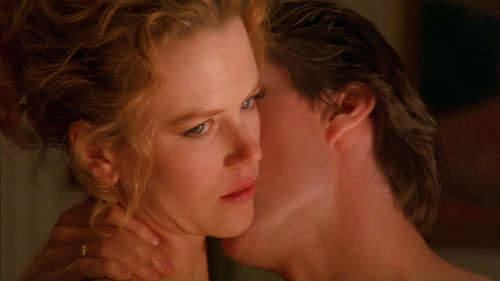
Some of Cruise's best acting lies in that mask
Often we miss what is right in front of us, can't see what is right in front of us, or just plain don't want to. The world outside is scary, we prefer to stay inside away from the strange and terrifying. Yet, that curiosity, you know, the one that killed the cat, it gets the best of us and we seek to know that which they say we shouldn't. That is not what this film is about, at least not at its heart, and it is a very heartfelt film. Like all of Kubrick's films there is an almost psychotic attention to detail, but it is shown differently in this film. This film is rough, in much the same was Chainsaw Massacre is, it does not have the perfectly manicured shots of 2001, or the slow deliberate horror that was the Shining, it has its own identity, and seeks to define that thoroughly from everything to the lead actors to the music to the colors. At the very core of its being, it's about fucking.

That's not entirely fair, nor descriptive, but sums up many of the scenes, in its rudeness and abruptness, and strips it down bare, to what is left when you film people like he did. The last scene is succinct but also incredibly long-winded, and then it ends. The film, the mystery, all of it ends in such an abrupt way the audience is left with mouths open-mouthed at the sheer audacity of it, and it could be compared to the Sopranos in terms of resolving what happens. We're left with an obscene term, with the rhetorical question, "Well you know what we have to do now. Fuck." That's it, roll end titles. The ending is not the only ploy that Kubrick plays however, only one of many in his masterful manipulation. Let's go back to the beginning, it is always best to start there.

First. Quick. Reverse text title, director, actors. Done. Nicole Kidman's naked back. Done. That is the end of the eroticism in the film, none of the nudity is portrayed as such, and given the circumstances it is often simply revealing of the characters, bared naked not simply nude. I'll compare it to the Dreamers for simplicity, since both featured nudity fairly heavily, but neither was anywhere near pornography, no matter what detractors may say, because the sex or nudity is far beyond the point, and is only used as a tool, not an end. Next the film shows Tom Cruise and Kidman going about their daily lives, dressing up for a fancy party, they engage in what is routine, the first sign that something is not quite right.

I don't want to reference the title but...
I should note the setting now, it's Christmas time. Boy do directors love using Christmas for the irony they can get out of it, and also as a comment on the culture. Other notable films set at Christmas: Brazil, Die Hard, Batman Returns. Cruise is given a number of gifts throughout the film, though I don't think any were really selflessly given, or true gifts. He however sheds money like there is no tomorrow, and at a point he thought that was possible. It's an interesting note about gifts as a whole, one which is not really looked at a lot, in that people who think they have nothing left are willing to give everything.

Back to the plot, the young couple go to a big extravagant proper party, a contrast to the depraved orgy that goes on later, and both flirt with affair, but neither really looks like they might go through with it, because no matter what their marriage is, it is stable, and something they want to keep alive. Unfortunately when drunk Kidman reveals that she imagined having an affair while they had sex, this infuriates Cruise and he leaves to wander the streets. This is where he eventually discovers the masked party the film is famous for, and realizes just how fucked up the city can be. In many ways his character reminds me of the eponymous character from American Psycho, but he never goes crazy, something I was actually looking forward to but oh well.

He is well dressed, and presents himself well, as well as dealing with some of the seedy underbelly, prostitutes and orgies, but I suppose the real difference is control. The character from American Psycho is totally in control of his life/fantasy, and lives it with this in mind, Cruise's character, really isn't. When he seeks explanation he finds only confusion, when he tries to understand he comes close to getting his family hurt. He has no control, and seeks to reconcile this throughout the entire film, and is actually unsuccessful. In the end he is simply a cog in the machine, a doctor who determines how people live and die everyday, but who has no real control over the events that happen around him, one of those ironies that live simply loves to deal out. Though they are so rarely appreciated.

Irony thy name is Dream
I suppose the film is a romance, if one wants to go strictly by genres, but the female lead has some important scenes for the first half hour, then maybe the last 15 minutes, leaving her absent for about 2/3 of the film, and the romance is pretty crappy if that is what you're looking for, a sappy love story. It also fails if you're looking for sophomoric porn, but I doubt many people go into a Kubrick film looking for that. It's a noir film where nothing is revealed, and the mystery may not even be real. Wikipedia goes with drama, the archetypical genre, though going by archaic definitions we could call it a comedy, based off the sort of happy ending. Hell out of all the films I've seen recently it has the happiest ending, one where no one important died, just a lone druggy that no one cared about but who was the only character who cared about the protagonist. Now I'm sad.

The film looks at all the evils in society, and it scoffs. It looks at the elites with their strange doings and politely asks not to question, because there is no question worth asking. It looks at the nature of economy and the way humans contribute to it, and says do whatever, because the world will not change by your will. It takes a definite stance on society, one neither inherently pessimistic nor optimistic, it simply is. The film is about life, which simply is, it begins and ends when it does, and there is no point questioning it when it does. That's not to say that questioning shouldn't be done, it just rarely helps to ask the world why, because any answer you get will be wholly unsatisfactory, and likely from  a crazy person walking past. The world is full of crazies who demand things from the air, or the sky, but doesn't that make the crazies normal?

Anyway like all of Kubrick's it is masterfully directed with a unique tone and message, and a unique way of showing it off, showing all the ruins of society at odds with the posh parties and elements of the elite which stay with that 1%. I suppose it might be more relevant now with the occupy movement, and it has been looked upon in a more positive light lately, as it should be. Fucking brilliant is the final conclusion, with the added note that for some strange reason the mask the Cruise wears terrifies me more than anything from the Exorcist. Just look into its soulless eyes and say you are not staring into the depths of Satan's Soul.


Tuesday, January 17, 2012

The Dreamers

An important scene about love
The Dreamers is a strange film about revolutions, both sexual and political, and one could say it is a bildungsroman, though in a very non-traditional sense. It follows the story of a teenage American boy who has recently moved to Paris who is attempting to fit in amongst some fellow cinephiles and ends up moving in with a brother in a sister, who have an incestuous relationship, this is incredibly awkward until he directly addresses it, then has a passionate love with the sister, though becomes embroiled in something much bigger than himself, the revolution talked about throughout the entire film, both metaphorically and literally. It is set in 1968, which really is the perfect time for the piece, and it is very much a period piece.

First a historical note. The film is set during the beginnings of one of the biggest protests ever. Over 11 million french people were on protest at one point, almost one quarter of the country. These riots involved peaceful demonstrations but quite quickly evolved into direct violence, and almost a sort of anarchy. It ended the contemporary government's reign, so it was effective in that sense, and also prefixed a lot of social changes that were so prevalent during the 60's. The most important for this film was the sexual revolution, as an era of freedom and expression began, and created the culture that is so relevant today.

The film begins with a fairly catchy tune, evocative of much of the soundtrack. The soundtrack is actually concurrent with the era, so it is all 1968 or before, which creates a very unique feel to the film, which is further evoked by the cars and technology of the era. The opening credits are set to a background image of the Eiffel Tower, which is inherently a symbol of change. We're then introduced to our protagonist and narrator, who is fairly likable even if I don't remember his name. He walks to a cinema built in a metaphorical palace, which looks like a truly magical place, fairy-tale like, which is what the film tries to evoke through much of the second and third acts.

Not my style, but still damn pretty
So at this he meets the initially domineering and dangerous Isabel in a beret, like Che Guevara, and then we see her in chains protesting the shutting down of the cinema. It is there that she invites him home, and we begin the journey down the rabbit hole, but we don't really see how deep it goes until the parents leave. But the film is not strictly about revolution against the parents, merely how without parents/authorities revolution is inevitable. When Isabel contemplates suicide at the end because her parents have found out about her relationship with her brother we realize how powerful this parental relationship can be, and what it can do to people to have their parents realize who they truly are, again a metaphor for government. The film is also about film.

When I say that I mean it is a tribute to an era of film-making, and music, and philosophy. It knows the time better than many pieces from the same time. In a way it can be compared to Tarantino's films, in that he knows the period he is referencing, and with his encyclopedic knowledge of films it shows. The difference here is Tarantino's references are implicit, and the Dreamers are explicit. The Dreamers shows the films it is referencing, names them, shows how the characters know them, and though more appreciation is gained for having watched the films a casual viewer, not that there really are any with this film, still can understand them. Tarantino's are more take it or leave it, if you get it good, if you don't well it's brief and unimportant. Different style of film-making, neither implicitly better or worse.

When I say it's a tribute to the philosophy of the time I mean it's about the revolutionaries that became so popular in the 60's, due in part to the Vietnam war and disillusionment and also because of the media which influenced people so. Films like Psycho that sought to break the social norms, and acknowledge the madness that lies outside, and others like To Kill a Mockingbird showing the racial injustices prevalent at the time and how god damn ubiquitous they were. These films revolted in small ways, and the riots in Paris at the time were simply a microcosm of what was happening around the world. The film shows this perfectly through its explicit imagery, through its dream-like state and the refusal to acknowledge the outside world, the issues of appearance versus reality and all that jazz.

No penises here
Now to talk about why the film got an NC-17 rating. It has full frontal nudity, like a lot. If you're offended by that, well this is not the film for you. It also has explicit masturbation by a male, incest in everything but the most technical sense, and several sex scenes, including one which is about five minutes long. There are a number of reasons for this, notably with sexual revolution as a predominant theme it had to include some nudity, because otherwise the point would be neutered, it helps to define the characters more than without it, and it's just the director's way. Just as Tarantino uses excessive violence, Bertolucci uses excessive sex. Both uses of the word excessive here are simply compared to the norm, and they really are not excessive to me, but simply to the censors.

The director, Betolucci, clearly loves the subject matter, and it is evident in all the choices made about the film. The philosophy in the film, evidenced by several different characters in different ways seems like it was someone's personal philosophy, about how every element of the universe works together to form a wholly together whole. A nice optimistic idea in a sense. Interestingly the film ends on quite a sorrow note, or even no note at all given how open the ending is. The brother and sister go off together, ignoring the protagonist's cry to break apart and to live their own lives. The film actually ends on a small fire burning, with police vans in the back after all the riot cops have run forward to intercept the virtual army of protestors.
On the whole I'm not sure if it is a comedy or a tragedy, using the classical terms. The ending is not wholly ambiguous, but leaves enough up to question, about the fates of the main characters as well as that of Paris as a whole. It is a lot like reality in that way, but only really the ending and beginning are. The rest of the film is so unreal, that it is less realistic than the likes of Star Wars, or for something more grounded in reality Donnie Darko. Films which thrive on their fictitious nature are more real than a film rooted so firmly in reality in terms of setting, but is so far apart in terms of characters and style. As I said, I don't know what to think, I'd say give it a watch if you're fine with explicit sex scenes, but be ready for something very unique, an entity unto itself.

I'm actually not sure if I'm done with this one, I feel like there is more to say on that theme of appearance versus reality, so stay tuned for a second part, maybe.

To add some class

Tuesday, January 10, 2012

Forget it , Jake. It's Chinatown.

Don't expect a happy ending
From films like A Clockwork Orange and Brazil we have a film so grounded in reality it shows detectives doing what they actually do, trying to sort out messy divorce cases. It bills itself as a neo-noir film, and I suppose that assertion is right, but again it is such a real film that noir seems the wrong term, because nothing in it is quite so outrageous as the typical situations involved in the genre.  So one of the classics of an era filled with great movies, from the Godfather duology ( When you have such great films as those you ignore any others) to the great bond films of the era, featuring Connery at his best. What makes this unique though, what makes it stand out from the rest?

Well first of all it has Jack Nicholson, a very young Jack Nicholson but still the same damn good actor. Then the supporting cast is great as well, but what really stands out is the script, which according to some sources is "the best ever written." That's fucking high praise. Another thing that the film has going for it is that it knows the genre, the screenwriter, director, and actors all know what kind of movie they're making and seek to subvert it whenever possible, leading to disastrous consequences.  The final thing the film has going for is the ending, but I'll get to that later.

For now we'll look at the opening credits, which are fairly generic in terms of presentation, just overlaid on a bland background, disappointing but what can you do. The film begins with our protagonist, Nicholson, doing what he does best, proving a wife is cheating on a husband, and he is then tasked by another woman to investigate a cheating husband. A surprisingly accurate portrayal of what detectives do. He does this in his signature style, and sure enough before the film is over all hell has broken loose and a conspiracy on a fairly grand scale has been revealed. One of my favorite moments in the early film is when the chief water inspector is revealed to have drowned during a drought.

Appropriate for much foolishness
The irony of it had me laughing at least, and that kept me from too much sadness over the rest of the plot, because the irony of it is just so grand. Now the plot gets quite convoluted after this brief introduction, and there are many twists and turns, and eventually Nicholson decides that calling the police to a woman's house is the best idea, even though he knows it'll probably get him arrested, and it does. On the scale of irony the film rates pretty high, with the detective actually being an incredibly emotional and sociable guy, not the cold as ice badass typically shown in these kinds of films. I'll admit I prefer the Dude as the protagonist for a neo-noir, but Nicholson does it very well, especially in the more serious context.

And the film is very serious, deadly serious as it may be, and makes not real attempts at humor, at least not more than the extremely black kind. So the protagonist is a guy who just can't seem to get a break, but is at least trying to do the right thing, and even doesn't seem to care that much about the money, so we have a good guy at least. The cops seem to be incompetent at best, and actively detrimental at worst, leading directly to the end, and the end result due to their choices, which while somewhat sensible just leave the viewer wondering why. The villain is darkly evil, not of the Snidely Whiplash kind but more of the Ozymandias variety, he wants to leave the world a better place but his methods are worse than some mass murderers.

Now the ending, the most emotional part of most films, and this film is no exception, with nothing after the climax really, just cut to credits. No reassurance, no what happened next, just fade on one of the darker downer endings in cinema at the time. The protagonist accomplishes nothing, the woman he was trying to save dies, the fate of her daughter/sister is unknown, but probably bad, and the villain gets away scot free, and even profited somewhat from the whole encounter. Well Jesus can we get something positive in there? I guess Nicholson got payed a bit, and, um he got laid as well, I guess that's good. Honestly with the ending, there's nothing good, nothing positive, it's just an end, and like all ends if you let them go on for too long, it ends in death.
Here's some puppies
So the ending is depressing, it's a downer, and at that point there's no real recovering, after the ending in all likelihood Jack probably shot himself, but damn it that's why it ends, regardless of now non-ending like the finish is. What's weird about the entire film is it seems like it is a sequel to a previous film with the same name, because it seems like every character refers to Jack's previous experience in Chinatown, and what happened in Chinatown, and how badly it ended in Chinatown. So it honestly seems like this film is discussing events that already happened in a prequel, but the prequel doesn't, and will never, exist. It's a weird feeling for a film like this, but stunningly appropriate to the message.

Life goes on, that's the way it always is and always has been, things happened before but right now, this is what's happening, deal with the present not the past. A fine message I suppose. The way its presented lends to some questioning about how positive it's supposed to be, because honestly with the film's ending you wonder just what it is all supposed to mean, on a cosmic scale. Some of this is due to the director's miserable life, having his pregnant wife killed and he was a Holocaus survivor, that's a hell of a life. Literal Hell there, depending on your view of the underworld.

One final note is that the music is surprisingly sparse, punctuating a few moments with a few chords, or maybe the beginning of a song, but no full pieces, and no vocal songs either. I suppose that's just normal for the genre, but for me at least it's an interesting change of pace. See the film, but expect nothing good in the end, because that's the way it is. Nothing good ever really comes in the final end, but that's okay. Forget it, Jake. It's Chinatown.

Friday, August 12, 2011

Grave of the fireflies

I'll be brief since I have so little to write about this masterpiece of a film. Directed by Studio Ghibli this 1988 film is the tale of two orphans attempting to live in World War II Germany. Lot's of laughs. But mainly tears, so many tears. It is one of the strongest anti-war films out there, but also a warning tale about pride and learning to accept your mistakes, a fact which is often missed by critics who just see the admittedly powerful imagery directed against the pointless war.

The key point about the film is the little moments that it shows, the happy relationship the two children share, even if it is in the brief interludes of incredible depression. One of the most telling and for me touching moments of the film is when the little girl asks for her favorite candy, and is crying when she thinks there are none left. Then the big brother looks deep inside the can and finds a few pieces and some scraps, the little girl looks very carefully at what is left, and eats the scraps putting away the rest. This incredibly poignant scene is one of many, and just seeks to show how masterful Ghibli can be when it is in its element.

This is not a happy film though, it is an incredibly depressing film where in the end there is no happy ending. They both die, this is stated in the first minute of the film. The buildup to it though, even though you know the end result is what makes it so sad. I personally felt so much anger at the characters because many of the events could have been prevented, but where not because of basic human flaws. The tale makes much more sense and becomes much sadder when you here that it was based off a real account from a man who grew up in the period and blames himself for his sister's death.

This is an amazing film though, and I think everyone should watch it at least once, even if you don't believe that cartoons can be made for adults, maybe this film will change your mind, and will almost certainly change your heart, if only for a little while.

Sunday, May 8, 2011

Tales from the Toilet

Pulp Fiction was a film released by Quentin Tarantino in 1994, and has since been widely received as a cult classic, paradoxical as that may seem. What I'm talking about specifically here though, is how the world can change when we duck out of it for a second. This is evidenced by the use of bathrooms in Pulp Fiction, something ignored by just about every other film. Toilets are seen six times throughout the film, each preceding an important event, and directly or indirectly influencing it. All these show how the world is that of a changing environment, and that leaving only for a moment can have the biggest impact of all.

The first instance of the bathroom being used is by one Mrs. Mia Wallace, in Jack Rabbit Slim's. She goes to "powder her nose" and shows that she has an enormous drug problem, causing her to OD later in the film, starting a long chain of events. As she returns from the bathroom she comments on the phenomena of bathrooms, stating how it is "lucky to have food waiting for her", indirectly addressing the wider issue of how life can change as one examines it through an outside perspective, taking a moment, and that is all that is necessary, to observe one's situation from a decent distance, and to see what changes happen that are invisible to our naked eyes.

The next occurrence is soon after, as Vincent contemplates just what the hell he is going to do with Mia, given they are both high and drunk, and if anything major happens there is a good chance he will be thrown out a window, an occurrence quite explicitly detailed earlier on. Mia unfortunately tries to snort some heroine, resulting in a rather unfortunate situation, and a changing world after only a minute away. This speaks to the film as a whole, as the different disordered segments can be disorienting, when one story disappears only to reappear at a later time. The haphazard nature of all of this still seems very planned, possibly to simulate the eternal clockwork of life and its turns and twists.

The next two bathroom sequences occur in the golden watch tale, that of a boxer who killed  a man, and now seeks asylum from all the people out to get him. One instance simply helps to show intimacy between a  couple, providing contrast to the rape which happens later, quite an opposite indeed.  The other instance close to that one, is Vincent's final hurrah, as he steps out of the bathroom to find his death staring straight at him, as all his past deeds are catching up to him in this single instance of a man with a gun. He realizes this, and wonders just why everything had happened, as the disaster of his life is fully realized, the violence inherent in his profession is truly revealed in his own end, and Jules' interpretation of events may have been right. Wandering the earth doesn't sound so bad compared to the end.

Chronologically this event in the bathroom happened first, but in the film it is one of the last scenes. We have our Jerry Seinfeld look-alike waiting in the bathroom with a revolver "bigger than he is", listening to his friends die, himself dying on the inside. Soon thereafter he charges out firing rapidly, hitting nothing, and finding that his end was inevitable. This however does bring about Jules' reflections on God, miracles, and his profession, so some good did come of it. One life ends, another begins anew, as the world is changed completely, because one guy decided he need to take a piss. This is all best summarized by Jule's misquoting of a bible verse, Ezekiel 25:17, guiding the innocent through the valley of darkness as a Shepard.

The last, and perhaps least significant, is when Vincent retreats to the diner's safe haven, and comes out to find a hold up. Perhaps the most material of all these visits in its end result, it is still a very important moment for Jules, and the beginning of the end for Vincent. By finding these robbers, Honey Bunny and Ringo, we find the insatiable human need for material goods, and what lengths some people are willing to go to to get them. Jules here decides to give all the money away, including that of the other customers, in his attempt at charity, allowing them to live, and perhaps changing the way their lives will progress. Both him and Vincent then exit to the film's eponymous theme tune, and depart, one to his death, and one to a new life, all springing from a few moments which change everything.

So bathrooms seem insignificant in comparison to the larger themes of many works, including this one, but maybe something so necessary and yet glossed over or ignored in near every work is one of the most important. Often the things we forget are the ones which we truly need, evidenced by the Golden Watch, and sometimes the one thing we are searching for we can never truly find, like in Moby Dick. It all comes back to the little things, the unimportant details that mount up to an insurmountable pile of shit, reeking of forgetfulness, and the eternally lost miasmas of life.